
Lexicon Financial Group Weekly Update — March 11, 2026
“One-third of Americans have already been forced to change their lifestyle because their disposable income is gone. A guy can’t go to the corner bar after a rough day at work to have a beer, that’s gone to oil!”
From the desk of Craig Swistun, CIM, MFA-P, Portfolio Manager, Raymond James Investment Counsel, and Wayne Hendry, Client Relationship Manager, Raymond James Investment Counsel
ISSUE 219
Looking Around
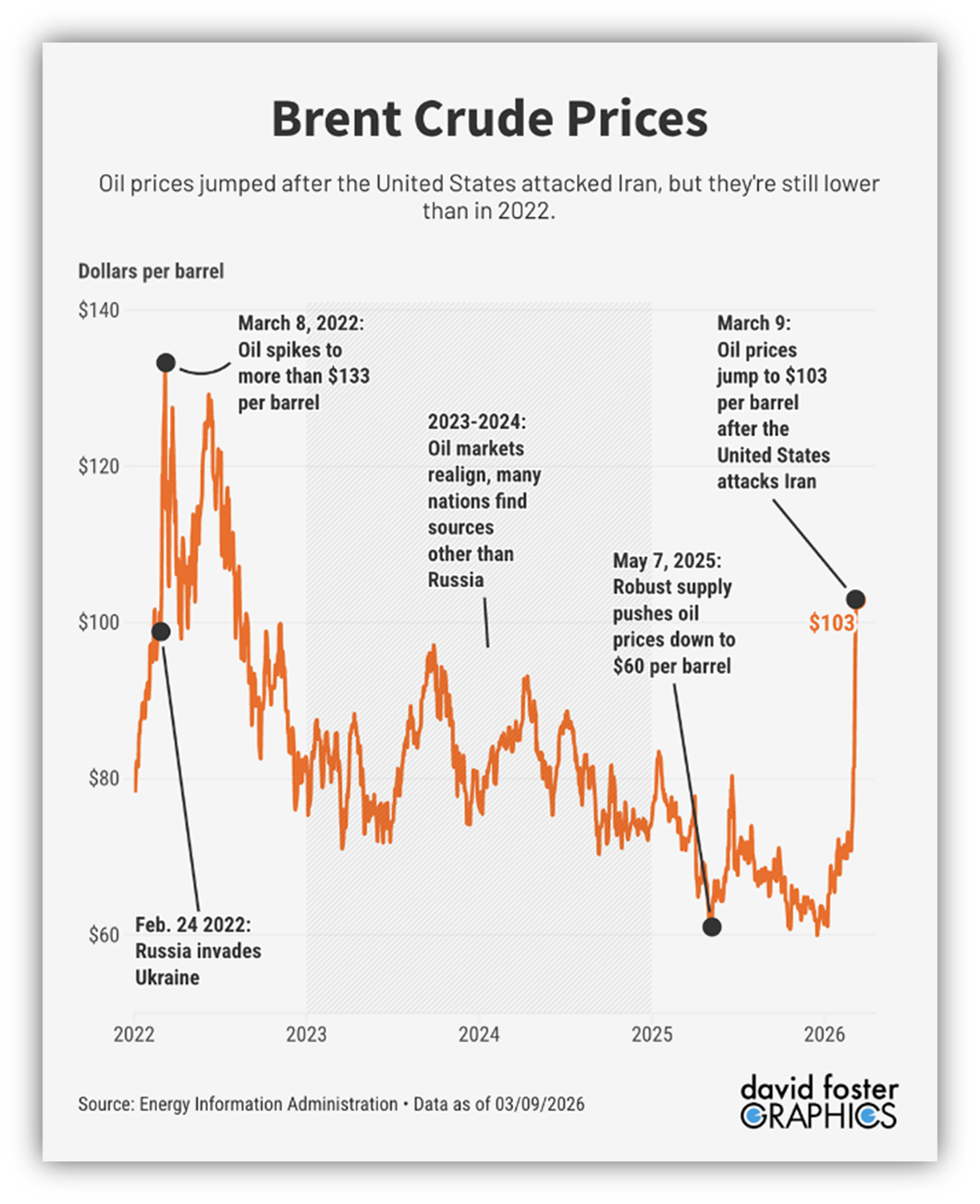
Source: The Pinpoint Markets
Call it a war, an incursion, or something else, missiles and drones have been flying in the Middle East for almost two weeks now. The global impact of this remains to be seen, but at home, the evidence of disruption to global supply changes is the price of oil.
At the time of writing this weekly update, oil prices were rising again after dropping to below US$80. Where they will be at the time you read this is anybody’s guess.
Oil traders are struggling to make sense of mixed messages from President Trump and some members of the Trump administration about the impact of the United States (U.S.) and Israel’s actions in Iran. For example, on Tuesday, Brent crude, the international benchmark, fell 17 per cent to below US$80 a barrel, before almost immediately rebounding to over $90 per barrel. Why? News. Or maybe fake news. U.S. Secretary of Energy Chris Wright posted on the X platform, claiming that the U.S. Navy had escorted an oil tanker through the Strait of Hormuz. Prices fell. He quickly deleted the post and White House Press Secretary Karoline Leavitt told reporters that there had been no armed escort through the strait, which has been effectively closed to shipping in the region due to Iranian threats. Prices rose. Oil prices are now tied to “tweets” on social media platforms.
Trump himself did not help this situation, when he stated that he expected the war to be over soon but that the U.S. will continue its attacks on Iran until it was totally and decisively defeated. This has forced Saudi Arabia, the United Arab Emirates, Kuwait and Iraq to cut oil production due to a growing stock of oil that cannot be shipped and storage capacity that is rapidly being depleted.
Currently, the knock-on effects of this rise in oil prices are still limited but a sustained rise in oil prices often push up the cost of everyday goods and drag down growth. According to an analysis by the International Monetary Fund (IMF), a 10 per cent sustained rise in oil prices typically corresponds to a 0.4 percentage point (40 basis points) increase in global inflation and a 0.1 per cent to 0.2 per cent reduction in global economic growth.
In the U.S., gas prices have risen about 17 per cent since the start of the war, while authorities in South Korea, Thailand, Bangladesh and Pakistan have introduced measures such as price caps and rationing to keep costs down. Canada has seen gas prices rise by approximately 9 to 16 cents per litre since the start of the conflict, with national averages jumping from around 134.2 cents to over 153 cents per litre by March 10, 2026. (1)
Even if the conflict were to end tomorrow, it’s not clear that oil prices will immediately fall. Restarting production and clearing up a backlog in shipping is not as simple as flipping a switch – it takes time. And, markets will also take time to recover from the threat that this disruption could occur, without warning, again. The Trump administration does not have time on its side to ride out the current situation before it becomes a thornier political problem. According to a recent Quinnipiac Poll, more than 7 in 10 voters in the U.S. said they are very concerned or somewhat concerned that the war will cause oil and gas prices to rise in the United States. Republicans are increasingly viewing the Iran war as counter to the affordability message, which is crucial to retain control of Congress in the upcoming midterm elections. (2)
The International Energy Agency (IEA) agreed to release 400 million barrels of oil to address the supply disruption triggered by the Iran war - the largest such release in the organization’s history. These reserves will be released over a time frame that is appropriate to the circumstances of each of its 32 member countries. The closure of the Strait of Hormuz has triggered the biggest oil supply disruption in history and energy analysts have warned ahead of the release that even the IEA’s maximum drawdown capability would likely not be able to offset the nearly 20 million barrels per day that typically transits through the strait. (3)
But it isn’t just oil that passes through the Strait of Hormuz, although you’d think so from the headlines. About one-third of the global supply of urea, a fertilizer widely used in agriculture, is shipped through the region. The halt in the flow of urea has not yet affected food prices, but some predict its impact could be felt in coming months. According to Leigh Anderson, a senior economist at Farm Credit Canada, supplies of fertilizer were relatively tight already, heading into this crop year before the war. So, the longer increased prices remain in place, the more of a compounding effect there will be on Canadian farmers. Benchmark prices for nitrogen fertilizer have surged about 30 to 40 per cent in the last week.
However, Aaron Stein, executive director of the Alberta Federation of Agriculture, has said that the supply issue would be a “blip on the radar" if shipping returned to normal within days. Also, according to Stuart Smyth, an agriculture and resource economics professor at the University of Saskatchewan, in the short term (two to three months), grocery prices are shielded from sudden spikes due to pre-existing contracts, so the impact would be pretty minimal and under one per cent. (3)
Before the start of the war, the U.S. economy was in a relative position of strength. Leading indicators released this week showed services continuing to lead and manufacturing recovering toward expansionary territory. Prices paid within manufacturing were elevated by a business environment wrought by tariffs. Broader inflation was expected to remain contained, which provided the U.S. Federal Reserve (Fed) room to lower interest rates. A prolonged and sustained closure of the Strait of Hormuz could push up inflation, which means interest rates stay higher for longer.
We are always evaluating different ways to diversify investments, protect capital, and invest in areas that are positioned for long-term growth. It’s easy to remind people of the impact COVID had on markets six years ago. Staying disciplined is always the best course of action.
Read and Watch
Want deeper insight into topics in your Weekly Update? Then, read and/or right click:
How Worried Should Canadian Stock Investors Be About the Iran War?
Treasury yields edge higher as investors monitor the latest on the U.S.-Iran war
Middle East conflict could affect Japan’s economy significantly, says BOJ's Ueda
Looking Back
Last week was quite a week for stock markets. What with a surge in oil prices, thanks to the Iran war, which heightened anxiety about higher inflation, while a weak payrolls report spurred growing fears around U.S. economic growth.
The S&P/TSX composite index (TSX) ended last week in negative territory. It was down -3.7 per cent as most sectors saw declines. With the Iran war showing no signs of ending, analysts are warning that it could drive up costs across Canada’s supply chains and compound price pressures at the grocery store in the weeks to come. According to Fraser Johnson of the Ivey Business School at Western University, despite the fact that Canada doesn’t get oil or natural gas from the Gulf region, Canadian consumers could feel the jump in global energy prices beyond the gas pumps. (4)
Given the oil market volatility last week, it is no surprise that all major U.S. stock markets finished last week lower in the wake of U.S. and Israeli military strikes on Iran, rising energy-driven inflation risks, and some mixed economic data. Uncertainty about the conflict’s duration and its potential impact on energy markets also drove U.S. Treasury trading, pushing yields higher as investors reassessed inflation risks and the outlook for Federal Reserve policy.
Investor sentiment was also not helped by the Bureau of Labor Statistics report that nonfarm payrolls declined by 92,000 in February – well below expectations for a gain of around 60,000 – and that the unemployment rate ticked up to 4.4 per cent. This could complicate decision-making by the Fed, as policymakers balance signs of labour market cooling against potential inflation pressures from rising energy prices amid escalating conflict in the Middle East.
After several consecutive weeks of gains, the pan-European STOXX Europe 600 Index, along with other major European stock markets, ended last week down. It appears that risk appetite in Europe has deteriorated significantly, following U.S. and Israeli military strikes on Iran and the subsequent widening of the conflict across the Middle East. The surge in oil and gas prices has exacerbated concerns about the effects that prolonged higher energy prices could have on economic growth and inflation.
Data released by Eurostat, the European Union’s statistical agency, showed that even before the Iran war, annual inflation in the eurozone hit 1.9 per cent in February. This is higher than the 1.7 per cent registered in January and above market expectations. Traders’ expectations for monetary policy shifted dramatically, with the probability of the European Central Bank raising rates increasing to more than 50 per cent. On the economic front, the seasonally adjusted unemployment rate in the eurozone fell to an all-time low of 6.1 per cent in January – a level that was marginally lower than both the previous month and analyst expectations. Youth inflation also declined to 14.8 from 15 per cent.
Japan’s stock markets fell sharply last week, amid uncertainty about the duration and scope of the conflict in the Middle East. Investors attempted to assess the potential impact of higher crude oil prices on domestic inflation, given Japan’s significant reliance on oil and gas from the Gulf region. Bank of Japan (BoJ) Governor Kazuo Ueda said that depending on how the situation unfolds, the impact of the war on the global economy and Japan’s economy could be significant. This impact could be felt through channels such as crude oil and other energy prices, as well as international financial markets. Ueda reiterated that the BoJ will continue to raise interest rates if the economy and prices move in line with its quarterly projections.
China’s equity markets also retreated last week, as investors weighed the escalating conflict in the Middle East, along with its implications for oil prices and global growth, against Beijing’s newly unveiled growth target and policy signals.
The Chinese government outlined its economic priorities for 2026 at last week’s National People’s Congress and set a GDP growth target range of 4.5 to 5 per cent for 2026. This is the lowest since at least the 1990s and the first reduction since 2023. The budget deficit is projected to be around four per cent of GDP, which is roughly in line with last year, while the consumer inflation target remains at two per cent. (5)
The opinions expressed are those of Craig Swistun and not necessarily those of Raymond James Investment Counsel which is a subsidiary of Raymond James Ltd. Statistics and factual data and other information presented are from sources believed to be reliable, but their accuracy cannot be guaranteed. It is furnished on the basis and understanding that Raymond James is to be under no liability whatsoever in respect thereof. It is for information purposes only and is not to be construed as an offer or solicitation for the sale or purchase of securities. Raymond James advisors are not tax advisors, and we recommend that clients seek independent advice from a professional advisor on tax-related matters.
Oil prices swing wildly amid mixed messages over Iran war, John Power, Al Jazeera, March 11, 2026
The White House isn’t panicking about oil prices. That may change in a few weeks., Megan Messerly and Nahal Toosi, Politico, March 11, 2026
IEA agrees to release record 400 million barrels of oil to address Iran war supply disruption, Spencer Kimball and Sam Meredith, CNBC, March 11, 2026
Canada, U.S. stock markets fall as oil prices climb above US$90 a barrel, Daniel Johnson, The Canadian Press via CityNews Everywhere, March 6, 2026
Global markets weekly update - Conflict in the Middle East, rising energy prices drive sentiment across most markets, T. Rowe Price, March 6, 2026
SUBSCRIBE
If you’d like to automatically receive the Weekly Market Update by email, enter your email address in the box below.
We respect your privacy, and you can always remove yourself from the mailing at any time.
Looking to Learn?
If you want to know more about some of the topics we wrote about this week, just click on the links below:
Video: Could the US-Israel war with Iran fuel global inflation?
How will the Iran war affect the global economy?
International Energy Agency (IEA): Meaning, How it Works, Members
