
Lexicon Financial Group Weekly Update — June 17, 2026
“An IPO is like a negotiated transaction – the seller chooses when to come public – and it’s unlikely to be a time that’s favourable to you.”
From the desk of Craig Swistun, CIM, MFA-P, Portfolio Manager, Raymond James Investment Counsel, and Wayne Hendry, Client Relationship Manager, Raymond James Investment Counsel
ISSUE 233
Looking Around
The story that topped the headlines last week was the initial public offering (IPO) of Elon Musk’s space and artificial intelligence (AI) company, SpaceX, which raised a record-breaking US$75 billion last Thursday.
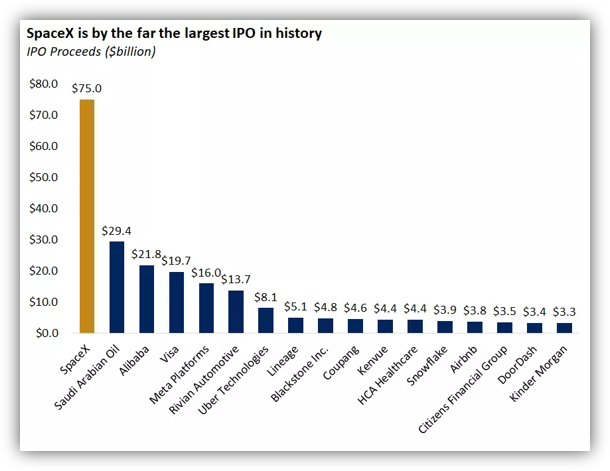
Source: Factset
This is the biggest IPO ever. And thanks to the SpaceX underwriters exercising their overallotment of shares (which happens when there is more investor demand), the total raised increased to US$85.7 billion. (1)
Those that benefited from this IPO were Elon Musk, SpaceX employees, early investors like the Ontario Teacher’s Pension Plan and the IPO underwriters. Those that bought into the IPO now own a piece of the potential of SpaceX going forward as well as the risk that comes with it. Whatever happens to the stock in the coming months and years, the early investors have certainly earned a nice payday.
Financial markets attract IPOs, and some of them come with plenty of hype. Maybe to some, “markets” is short for “marketing.” It can be easy to get caught up, but it’s always wise to be disciplined and cautious.
Generally, we don’t scramble to participate in IPOs for clients. Historically, there are plenty of examples of companies where the stock begins to falter soon after going public. Rather than rushing in to buy the stock, it might be worth waiting to see how the newly issued IPO shares perform in the market over a period of time. And, if an investor has to jump onto an IPO, it might be better to consider buying shares in small quantities over time rather than going all in at once. This is actually one of the additional advantages to investing in an exchange-traded fund. As the underlying stocks that compose the index grow and change, so too does the allocation each investor receives in their portfolio. Not an outsized bet on one company; a reasonable bet based on how that important company is in the marketplace at the current time.
The vast majority of our clients are longer-term investors. By now you’ve heard the old adage: when it comes to investing, time in the market is more important than timing the market.
Achieving greater returns comes with greater risk, especially during short-term market gyrations. Longer time periods smooth out the volatility. That’s why one of the worst strategies in disciplined portfolio management is to chase hot stocks or returns. Sure, you can win big, but you can also lose big too. Our approach is more prudent, focusing on maintaining an asset allocation that matches your time horizon and risk tolerance as well as helping you live with through the ups and downs. (2)
SpaceX has captured the imagination of investors globally, as demonstrated by their record-breaking IPO. But not everyone is buying into the hype, preferring to wait until actual results from business activities are better known.
Read and Watch
Want deeper insight into topics in your Weekly Update? Then, read and/or right click:
Video: How Should Canada Handle CUSMA & Trump?
Gas prices are coming back down. US inflation woes aren't over yet.
ECB: Iran Peace Deal Won't Erase Europe's Energy Price Shock
Japanese economic 'normalisation' ushers in significant investment opportunities
China economy weakens further in May as retail sales post first drop in over three years
Looking Back
Last week, the S&P/TSX Composite Index (TSX) rose to a record high on Monday, led by metal mining shares, as investors globally hailed a preliminary agreement to end the war in the Middle East and reopen the Strait of Hormuz. This is quite the turnaround from the previous week, when the TSX posted its biggest decline in nearly four months. For the week, the TSX was up one per cent. On the economic front, Canada's Ambassador to the United States, Mark D. Wiseman, said that discussions with Washington on reviewing the U.S.-Mexico-Canada free trade pact were productive and respectful. (3)
Major U.S. stock indexes ended last week higher, as cautious optimism around a possible U.S.-Iran agreement, declining oil prices, and continued broadening beyond large-cap technology shares helped offset mixed inflation data and volatility in artificial intelligence (AI)-related stocks. Small-cap equities led the advance, with the Russell 2000 Index rising 3.9 per cent, while the Dow Jones Industrial Average, S&P 500 Index, and Nasdaq Composite all added over 0.65 per cent. The Russell 1000 Value Index outpaced its growth counterpart for the second week in a row.
The Middle East situation remained a major driver of sentiment throughout last week, with investors initially looking past weekend missile exchanges between Iran and Israel, before reports of additional U.S.-Iran hostilities raised escalation concerns. Risk appetite improved late in the week, however, following reports of progress toward a U.S.-Iran agreement and President Donald Trump’s cancellation of planned strikes. Also, the highly anticipated IPO of rocket and satellite company SpaceX was also a major focus during the week, with the company completing the largest IPO on record on Friday.
According to data from the Bureau of Labor Statistics, consumer prices rose at the fastest annual rate in over three years in May. The agency reported that its consumer price index (CPI) increased 4.2 per cent year over year – the highest reading since April 2023 – driven mainly by a sharp rise in energy prices. However, the CPI rose 0.5 per cent on a month-over-month basis, down from April’s 0.6 per cent increase and marking the second consecutive month of decelerating price growth. Core CPI—which excludes food and energy costs—also moderated, rising 0.2 per cent compared with 0.4 per cent in April. Headline producer price growth accelerated in May, with the producer price index (PPI) up 6.5 per cent year over year, This is up from 5.7 per cent in April and the highest reading since November 2022.
The pan-European STOXX Europe 600 Index ended last week up 1.69 per cent. Other European markets were mixed ahead of the European Central Bank’s (ECB) interest rate decision last Thursday while geopolitical tensions continued to weigh on investors as the U.S. and Iran conducted military strikes. Sentiment, however, improved at the end of the week on rising hopes that a peace agreement would be reached.
Japan’s stock markets declined over a highly volatile week. These losses were partly offset by a sharp rally on the final day of the week, as U.S. President Donald Trump pulled back threatened military strikes against Iran and invigorated hopes that the U.S. and Iran could be closer to signing a peace deal, which could pave the way for shipping in the Strait of Hormuz to restart.
In China, stock markets ended last week mixed during the week, as stronger-than-expected trade data contrasted with continued signs of subdued consumer demand amid continued resilience in parts of the private and technology sectors.
China’s exports, which remain a key growth engine for the Chinese economy, rose 19.4 per cent year over year in May, exceeding market expectations and accelerating from 14.1 per cent growth in April. According to data released by the General Administration of Customs, imports increased 27.4 per cent year over year, while the trade surplus widened to USD 105.4 billion from USD 84.8 billion in April. While trade data pointed to resilient external demand, inflation data highlighted the uneven nature of China's recovery. China’s PPI, a measure of factory-gate prices, rose 3.9 per cent year over year in May – the third consecutive month of producer price increases. The PPI rise in May was the highest since July 2022. Consumer price inflation remained considerably weaker, with the CPI rising 1.2 year over year and unchanged from April.
This widening gap between producer and consumer inflation suggests upstream and export-oriented industries are benefiting from stronger industrial demand and higher commodity prices but household demand remains comparatively subdued. Deflation continues to be a challenge despite efforts by the Chinese government to get consumers to spend. (4)
The opinions expressed are those of Craig Swistun and not necessarily those of Raymond James Investment Counsel which is a subsidiary of Raymond James Ltd. Statistics and factual data and other information presented are from sources believed to be reliable, but their accuracy cannot be guaranteed. It is furnished on the basis and understanding that Raymond James is to be under no liability whatsoever in respect thereof. It is for information purposes only and is not to be construed as an offer or solicitation for the sale or purchase of securities. Raymond James advisors are not tax advisors, and we recommend that clients seek independent advice from a professional advisor on tax-related matters.
SpaceX IPO raises total of $85.7 billion as underwriters exercise ‘greenshoe’ overallotment option, Lora Kolodny and Chris Eudaily, CNBC, June 15, 2026
Ways to Help Reduce Risk in Your Portfolio, Mark Riepe, Charles Schwab, November 15, 2024
TSX hits record high as US-Iran deal boosts gold miners, Fergal Smith, Reuters, June 15, 2026
Global markets weekly update - ECB raises rates amid heightened inflation pressures, T. Rowe Price, June 12, 2026
SUBSCRIBE
If you’d like to automatically receive the Weekly Market Update by email, enter your email address in the box below.
We respect your privacy, and you can always remove yourself from the mailing at any time.
Looking to Learn?
If you want to know more about some of the topics we wrote about this week, just click on the links below:
Understanding Overallotment: Key Benefits and Examples
FIRST READING: Ontario teachers make billions from SpaceX IPO
Why Is SpaceX Stock (SPCX) Dropping? The Red Flags Experts Flagged Before the IPO
