
Lexicon Financial Group Weekly Update — January 7, 2026
“Invest for the long haul. Don’t get too greedy and don’t get too scared.”
From the desk of Craig Swistun, CIM, MFA-P, Portfolio Manager, Raymond James Investment Counsel, and Wayne Hendry, Client Relationship Manager, Raymond James Investment Counsel
ISSUE 210
Looking Around
Another year is behind us. As we embark on another tour around the sun, like clockwork, forecasts are emerging about how markets and economies will look in 2026. We read a lot of these – sometimes they are entertaining, sometimes they are enlightening. Rarely are they 100% correct.
Before we look at industry predictions for 2026, let’s take a quick look back at 2025.
When we started the year, we had no idea that headlines would be dominated by Trump tariffs, increasing concerns about artificial intelligence (AI), and geopolitical events, including conflict in the Middle East. Despite all of this, financial markets performed extremely well. A major index tracking stocks outside the United States (U.S.), the MSCI All Country World ex-USA, gained 29.2 per cent in 2025, which outpaced the S&P 500’s gain of 16.39 per cent.
The artificial intelligence boom benefited markets in Asia, where tech companies and chipmakers saw surges in demand last year. In Europe, markets received a boost from plans for government spending on defence and improved prospects for economic growth. A weaker U.S. dollar also provided a tailwind for international stocks, as when the greenback weakens, other currencies strengthen, and investments denominated in those currencies become more valuable when converted back into dollars.
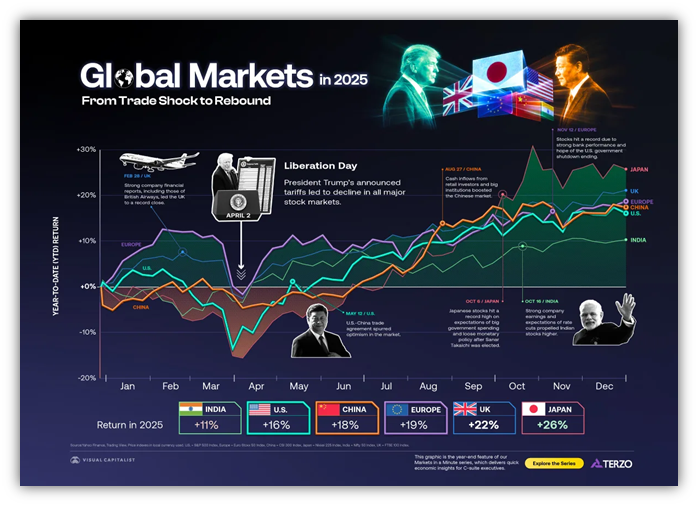
According to Lisa Shalett, chief investment officer at Morgan Stanley Wealth Management, one of the biggest and most underappreciated surprises of 2025 was the extraordinary outperformance of emerging market (EM) equities. She believes shifting geopolitical, monetary, and fiscal policy regimes amid technological upheaval and the constraints of developed world debt are leading to a need for diversification beyond U.S. stocks and bonds for long-term investors. (1)
We’ve already seen how unpredictable markets can be in 2026. A military intervention by the Trump administration in Venezuela that led to the capture and transfer of its president and his wife to New York to face criminal charges seems to have had limited impact on financial markets. Most analysts expect another year of gains for the U.S. stock market, but they also expect market volatility to remain elevated.
That said, as of mid-December last year, LPL Financial predicted the S&P500 will finish 2026 at around 7,629. This implies about 6 per cent upside from the end-2025 level. Also, analysts expect corporate profit growth to accelerate this year, driven by a resilient U.S. economy, deregulation, and a more supportive Federal Reserve (Fed) policy on interest rates. The U.S. economy is also expected to get a boost from the combination of this summer’s One Big, Beautiful Bill Act which provides U.S. taxpayers with an extra $100 billion in refunds. It is widely expected that those refunds will funnel their way into the purchase of goods and services as well as long-term investments by consumers.
The uptick in the U.S. unemployment rate is expected to lead to the Fed continuing to lower interest rates to support a labour market that appears increasingly imperilled. It is worth noting that over the seven most recent Fed easing cycles, stocks posted an average annualized return of nearly 28 per cent outside of recessions, compared with a 3 per cent pullback during recessions. (2) It's also worth noting that analysts have predicted twelve of the last five recessions… so there’s that.
The Morgan Stanley Global Investment Committee also believes the bull market still has room to run in 2026. With odds of a recession remaining extraordinarily low and double-digit growth in corporate earnings appearing likely, it sees the S&P 500 gaining 10 per cent for the year. However, it sees some reasons for caution. These include:
Tariffs still have the potential to increase costs for both businesses and consumers. This could lead to inflationary pressures and weaker demand.
‘Run it hot’ stimulus resulting from the issuance of tariff-related bonus checks to voters ahead of midterm elections, which could stimulate the economy and unleash new price pressures, even as the Fed tries to manage inflation. Also, a new Fed chair is to be appointed this year and will likely be ideologically aligned with the Trump administration’s aim to manage the growing U.S. debt pile through lower rates and running the economy hot—a strategy that also increases inflation risks. (3) (It’s also worth remembering that the current Fed Chair, Jerome Powell, was himself nominated by President Trump and appointed in 2018.)
That said, interest rates are expected to remain at their current low level for much of 2026, which bodes well for the financial sector as lower interest rates often help banks post stronger profits. This positive scenario could change if the joint review of the Canada-US-Mexico Agreement goes south along with any unfavourable tariff outcome for Canada. (4)
Globally, stocks are projected to return 11 per cent in 2026, according to Goldman Sachs Research. The world economy is poised for continued expansion in 2026, and the Fed is forecast to provide further modest easing. Peter Oppenheimer, Goldman Sachs Research’s chief global equity strategist, believes that given this macro backdrop, it would be unusual to see a significant equity setback/bear market without a recession, even from today’s elevated valuations. (5)
We most certainly read forecasts and research from other institutions, but we are not so foolish as to accept them as gospel. Historically, accuracy has been on average below 50 per cent. Market movements are often dominated by events that are impossible to predict. These “black swan” events have much more impact on the short-term financial markets. Over the long-term, though, these events tend to smooth out overall investment performance.
No analyst predicted COVID or its impact on the markets. No analyst can predict what 2026 will bring, so patience, discipline, and diversification remain the best approach to investing.
If you have any questions or concerns, you know how to contact us.
Read and Watch
Want deeper insight into topics in your Weekly Update? Then, read and/or right click:
Posthaste: Why 2026 may mark an 'inflection point' for Canada’s economy
Why so many Americans dislike this fast-growing economy
Europe's economy isn't collapsing – but let's not downplay the cost of geopolitics
Japan’s business leaders praise PM Takaichi’s economic policies
China's Economy is Expected to Grow 4.8% in 2026 Amid Surging Exports
Raymond James Markets & Investing: Ten themes for 2026 - CIO Larry Adam, January 2, 2026
Looking Back
The S&P/TSX Composite Index (TSX) kicked off the new year on a positive note last Friday despite downbeat domestic manufacturing data, as shares of uranium producers climbed. It ended the day up 0.5 per cent after declines in the previous four sessions. For the week, the TSX was down 0.4 per cent after posting a 2025 gain of 28.25 per cent. This was its biggest annual advance in 16 years, as surging gold prices, lower borrowing costs, and optimism around technology companies offset headwinds for the domestic economy. (6)
U.S. stocks declined during the holiday-shortened week. Within the S&P 500 Index, the energy sector was one of the few segments to post positive returns for the week as heightened geopolitical tensions drove oil prices higher, particularly early in the week. On Monday, the National Association of Realtors (NAR) reported that its Pending Home Sales Index—a leading indicator of housing activity—rose 3.3 per cent in November, marking the largest month-over-month jump since February 2023.
On Tuesday, the Fed released the minutes from its December 9–10 policy meeting, during which policymakers voted to lower the federal funds rate target range by twenty-five basis points (0.25 percentage points). The minutes revealed that most central bank officials believed further rate cuts would likely happen if inflation declined over time as expected. Market reactions to the minutes were muted, with stock indexes closing modestly lower on the day and the probability of a January rate cut remaining around 15 per cent.
In local currency terms, the pan-European STOXX Europe 600 Index hit a new high during last week and ended 1.26 per cent higher, buoyed by an improving economic backdrop in the European Union.
In a holiday-shortened week, both the Japanese and Chinese markets close the week on a down note. In China, this was despite the release of official data last Wednesday that showed that China’s manufacturing purchasing managers’ index rose to 50.1 in December from 49.2 in November, ending an eight-month contraction streak. The modest improvement in manufacturing supports the expectations of many economists that the Chinese government will likely take a measured approach to stimulus in 2026 even though some analysts think that it should roll out more aggressive measures to revive domestic consumption. (7)
The opinions expressed are those of Craig Swistun and not necessarily those of Raymond James Investment Counsel which is a subsidiary of Raymond James Ltd. Statistics and factual data and other information presented are from sources believed to be reliable, but their accuracy cannot be guaranteed. It is furnished on the basis and understanding that Raymond James is to be under no liability whatsoever in respect thereof. It is for information purposes only and is not to be construed as an offer or solicitation for the sale or purchase of securities. Raymond James advisors are not tax advisors, and we recommend that clients seek independent advice from a professional advisor on tax-related matters.
US stocks had a remarkable 2025. But international markets did much better, John Towfighi, CNN, January 4, 2026
Wall Street Expects a Solid 2026 for Stocks. But the 'Risks Are Growing', Colin Laidley, Investopedia, January 5, 2026
Will 2026 Tame the Bull Market?, Lisa Shalett, Chief Investment Officer, Morgan Stanley Wealth Management, December 17, 2025
2026 Canada Stock Market Outlook: Rally to Continue, but Gains May Be Tamer, Vikram Barhat, Morningstar, January 5, 2026
Global Stocks Are Projected to Return 11% in the Next 12 Months, Goldman Sachs, January 8, 2026
TSX kicks off 2026 with a gain as energy shares rise, Avinash P and Fergal Smith, Reuters, January 2, 2026
Global markets weekly update - U.S. pending home sales rise at fastest pace in nearly three years, T. Rowe Price, January 2, 2025
SUBSCRIBE
If you’d like to automatically receive the Weekly Market Update by email, enter your email address in the box below.
We respect your privacy, and you can always remove yourself from the mailing at any time.
Looking to Learn?
If you want to know more about some of the topics we wrote about this week, just click on the links below:
Despite AI Wobbles: S&P 500 Notches 16 Percent Gain in 2025
2026 Global Outlook – Blackrock Investment Institute
Global Equity Strategy 2026 Outlook: Tech Tonic — a Broadening Bull Market
2026 Global Market Outlook: The Great Inflection Point – Russell Investments
