
Lexicon Financial Group Weekly Update — January 14, 2026
“The beauty of diversification is it’s about as close as you can get to a free lunch in investing.”
From the desk of Craig Swistun, CIM, MFA-P, Portfolio Manager, Raymond James Investment Counsel, and Wayne Hendry, Client Relationship Manager, Raymond James Investment Counsel
ISSUE 211
Looking Around
For almost half of human history, our ancestors moved with the four-legged food supplies of their respective areas, leaving only traces of their lives in the form of cave drawings, stone weapons, and tools.
Although home ownership may be less affordable than it was in the past, it is still open to many. And we can thank the Industrial Revolution, one of the greatest economic equalizers in human history, for this. Albeit slow, the transfer of wealth to the working class and entrepreneurs meant more people, in more places, could purchase and own their own home.
Investing in real estate as an asset class has always been around. Buy a property, and if the value goes up, sell it for a profit. But it wasn’t until the 1980s that real estate as an asset investment class really took off. (1)
Today, investing in a real estate investment trust (REIT) or a real estate fund are both popular options. A REIT is a corporation, trust, or association that invests directly in income-producing real estate, trades like a stock, and generates income through dividends, which may make them attractive for passive income strategies. A real estate fund focuses primarily on investing in securities offered by public real estate companies. Real estate funds offer value through appreciation over the long term. Since REITs are listed and traded on major stock exchanges, they tend to be more liquid than fund shares, which can only be redeemed at the end of the trading day when the net asset value (NAV) is settled or at the end of a predefined period, say the end of a calendar quarter. (2)
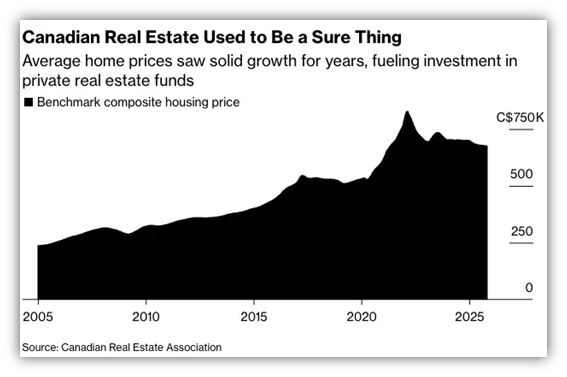
Many Canadian investors have come to treat real estate as a safe investment over the years. And why not? Canadian home prices rose steadily from 2002 through 2022 while outpacing the rate of inflation. Private real estate funds, once reserved for institutions and wealthy investors, started targeting professionals (doctors, dentists, teachers, etc.) and retirees. These clients were informed that they could own investments that included the solidity of hard assets and the convenience of regular payouts. The best of both worlds. Until it wasn’t.
As long as home prices kept rising and new capital flowed into investments, clients could invest and withdraw freely. When redeeming—for whatever reason—there was always enough excess cash in the fund to process the redemption.
When interest rates rose in 2022 and 2023, that dynamic shifted. Housing prices fell, and new developments stalled. Those seeking moderate returns could put money back into traditional bond markets to earn returns; they didn’t need to take on the additional risk of being in real estate. Redemptions increased.
Holding enough money to deal with investors that want an early or quick exit could drag down returns for investors who want to stay in the fund, so managers trended towards being “fully invested”. When redemptions exceeded excess cash, unless fund managers wanted to start selling the very “solid” assets they had worked so hard to acquire, they had to close the gates.
Temporarily suspending redemptions gives fund managers time to conserve cash and reset their strategies, but it comes at a cost. Investors who once believed in the power of real estate to build and preserve wealth realized that balance sheets and return profiles were useless if they couldn’t actually access their capital when they needed it.
Falling home prices revealed a structural problem within these real estate funds —condominium towers, warehouses, and construction loans—can’t easily be sold when you need to raise cash the way, for example, a stock or bond can be. It costs money to get a valuation and find a suitable buyer.
Also, data from the Canadian Real Estate Association has revealed that home prices have fallen 18 per cent from their peak. Population growth, a major driver of Canadian housing demand, has fallen to zero due to curbs placed on immigration. Fewer new renters and buyers means reduced absorption of housing units. (3)
Liquidity—the ability to get your money when you need it is never an issue until it is.
In recent months, several Canadian private real estate funds have frozen withdrawals and, in some cases, reduced distributions as well. Other well-known organisations have halted redemptions since 2022. That’s over three years without investors having access to their funds. Assets locked into any type of investments since 2022 could not be reallocated to other sectors of the economy. These assets would have missed two years of returns from the technology sector, for example.
As a portfolio manager, we take liquidity into consideration when we make investment management decisions. At this stage, the vast majority of clients are invested in exchange traded funds, precisely because we want to preserve liquidity in their portfolio. We value freedom and flexibility more than the promise of a potential higher return.
Read and Watch
Want deeper insight into topics in your Weekly Update? Then, read and/or right click:
Why haven’t Trump’s tariffs crashed the US economy?
German economy grows for first time since 2022
China aims to squeeze Japan’s economy with rare earth curbs
Looking Back
The S&P/TSX Composite Index (TSX) rose to a record high last Friday thanks to rising commodity prices and domestic employment data that reassured investors that Canada’s economy is holding up ahead of the review of The Canada-United States-Mexico Agreement (CUSMA) later this year. For the week, the index added 2.3 per cent - its biggest weekly gain in six weeks. Canada's job growth slowed in December, with the economy creating just 8,200 new jobs after three months of hiring increases. Analysts had expected a loss of 5,000 jobs. The materials group, which includes metal mining shares, rose 1.8 per cent as the price of gold moved closer to a record high. The price of oil rose and was up 2.35 per cent higher at $59.12 a barrel due to growing supply worries linked to intensifying protests in oil-producing Iran. (4)
In the United States (U.S.) stock markets advanced as investors largely looked past mounting geopolitical tensions. Small-cap and value shares outpaced the large-cap growth stocks that have led returns in recent years. The S&P 500 performed worst but still gained 1.57 per cent. Last week also saw several significant industry-level moves in response to a flurry of policy announcements from President Donald Trump.
Last week saw the release of a host of economic data releases, including several labour market reports that generally surprised to the downside. Most notably, the Labor Department released its closely watched nonfarm payrolls report on Friday, which showed that U.S. employers added a lighter-than-expected 50,000 jobs in December, while October’s and November’s readings were revised down by a combined 76,000. On the plus side, the unemployment rate ticked down to 4.4 per cent from a revised 4.5 per cent in the prior month. However, the Labor Department’s Job Openings and Labour Turnover Summary for November provided another sign of cooling in the U.S. labour market - hires declined to 5.1 million for the month, down from 5.4 million in October, while job openings dropped to the lowest level since September 2024 at 7.1 million.
Across the pond, the pan-European STOXX Europe 600 Index ended 2.27 per cent higher amid continuing optimism about the economy, company earnings, and a favourable interest rate backdrop. Other major European stock markets also ended up for the week. Also, the eurozone economy appeared to be strengthening toward the end of 2025 amid evidence that Germany may have turned a corner. On top of this, retail sales in the European Union grew in November by 0.2 per cent versus the prior month, while the annual rate picked up to 2.3 per cent, beating forecasts for 1.6 per cent after a major upward revision to October’s numbers. Meanwhile, headline annual inflation in the eurozone slowed to the European Central Bank’s (ECB’s) target of 2.0 per cent in December and down slightly from November. But services inflation, which is closely watched by the ECB, eased only slightly to 3.4 per cent.
Japan’s stock markets registered strong gains last week despite geopolitical and trade tensions between China and Japan. Technology companies in Japan continued to rally while yen weakness provided a boost to export-oriented companies and trading houses.
Mainland Chinese stock markets, fueled by artificial intelligence trades, also gained last week. On the economics front, inflation data showed that consumer price growth in China picked up in December, though producer prices fell for the 39th straight month. China’s consumer price index (CPI) rose 0.8 per cent in December from a year ago, which was in line with forecasts. The producer price index fell 1.9 per cent, the smallest decrease in more than a year. The core CPI, which strips out food and energy, increased 1.2 per cent for the third straight month.
Deflation rather than inflation has been a major challenge for China since the end of the pandemic, as a prolonged housing downturn and overproduction in several industries have weighed on domestic consumption and corporate profits. Inflation for 2025 was zero. This is the lowest level since 2009 and well below China’s official target of about 2 per cent. This data supports the view of some economists that China’s central bank will continue to ease policy in 2026. (5)
The opinions expressed are those of Craig Swistun and not necessarily those of Raymond James Investment Counsel which is a subsidiary of Raymond James Ltd. Statistics and factual data and other information presented are from sources believed to be reliable, but their accuracy cannot be guaranteed. It is furnished on the basis and understanding that Raymond James is to be under no liability whatsoever in respect thereof. It is for information purposes only and is not to be construed as an offer or solicitation for the sale or purchase of securities. Raymond James advisors are not tax advisors, and we recommend that clients seek independent advice from a professional advisor on tax-related matters.
No Longer Nomads: The History of Real Estate, Andrew Beattie Investopedia, March 31, 2025
Understanding REITs vs. Real Estate Funds: Key Differences Explained, Adam Hayes, Investopedia, November 19, 2025
Canadians Are Furious After Real Estate Funds Lock Up Their Money, Paula Sambo, Financial Advisor, January 12, 2026
TSX posts biggest weekly gain since November as economy adds jobs, Fergal Smith, Reuters, January 9, 2026
Global markets weekly update - U.S. labor market shows signs of weakness, T. Rowe Price, January 9, 2025
SUBSCRIBE
If you’d like to automatically receive the Weekly Market Update by email, enter your email address in the box below.
We respect your privacy, and you can always remove yourself from the mailing at any time.
Looking to Learn?
If you want to know more about some of the topics we wrote about this week, just click on the links below:
What Happens When ‘Safe’ Real Estate Funds Close the Gates
