
“Technology is so much fun but we can drown in our technology. The fog of information can drive out knowledge.”
ISSUE 251
Looking Around
During the last decade, it seems that technology has been developing faster and faster. Multiple technology sectors have grown at rates that dwarf previous technological revolutions. The convergence of artificial intelligence (AI), cloud computing, mobile technology, and data analytics have fundamentally reshaped how we live, work, and interact with technology and each other.
The acceleration we have experienced in the last 10 years has been anything but gradual. The numbers tell a story of technological advancement that compressed what should have been decades of progress into a few years.
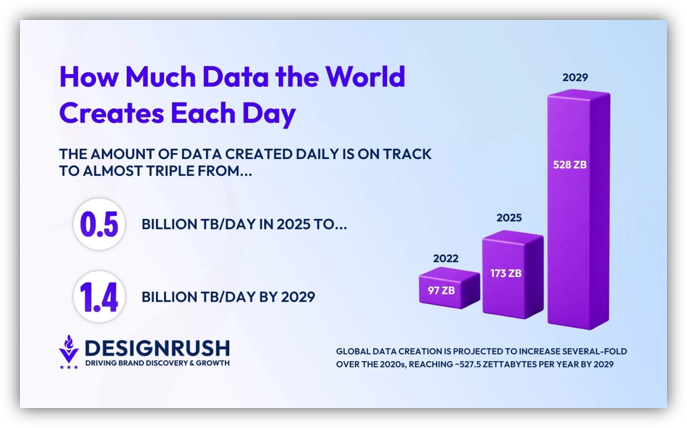
One of the results of this rapid advancement is the explosion of global data. Global data volumes reached 149 zettabytes (ZB) in 2024 – a 3,000 per cent increase from 2014 levels. To comprehend this scale, consider that humans now generate 1.7 megabytes of data per second per person, more information than was contained in entire libraries just a few decades ago. (1)
According to Marija Naumovska, Director of Development at DesignRush, approximately 173.4 ZB were created in 2025, and about 230–240 ZB will be created in 2026.
By 2029, this number is expected to almost triple to 527.5 ZB.
The effects of this can be seen in the news, as major news organizations and global media wires produce tens of thousands of articles every day. Added to this is all the AI-generated news and social news that encompasses millions of posts, shares and videos. Not to mention, content creators churning out videos for platforms like YouTube and TikTok.
With so much focus on technology, it’s easy to get caught up in the hype. But the hype can be short-lived, especially if you ask people who bought into the NFT (non-fungible token) market, hoping to strike it rich.
Ultimately, it’s still news that drives investors, heavily influencing short-term market movements and emotional trading behaviour. Short-term market movements are frequently driven by headline news, but what about the long-term? Over weeks, months, and years, the influence of individual headlines tends to fade. The fundamental drivers of company value, earnings growth, competitive advantage, or technological innovation, ultimately reassert themselves. Remember the dire headlines (for example, “Wall Street Suffers Worst Day Since 1987 Crash”) in March 2020, when the pandemic shutdowns began and markets plunged. Long-term investors who stayed put or systematically invested likely came out ahead, as the subsequent recovery unfolded. Short-term traders may try to ride these headline waves, but for us, a disciplined approach focused on underlying value is what pays off. This highlights the need to separate signal from noise. Doing this successfully requires us to:
1. Recognise Sensational Language: If a headline uses loaded terms like “crash,” “explodes,” or “catastrophe,” there’s a good chance that it’s designed to provoke strong emotions rather than inform.
2. Identify Selective Data Presentation: Sometimes only the most eye-catching part of an announcement is spotlighted. Positive earnings you say? Well, the headline may still highlight a single missed target or negative guidance.
3. Ignore Implicit Calls to Action: Words like “Investors Rush In” or “Sell-Off Ensues” can nudge us toward certain behaviours, even if the underlying news is ambiguous or not clear. The best action to take is to simply ignore these.
The world is full of data, but not all of it is useful. Developing a critical eye and looking beyond the headline to the full story, or even better, looking at multiple sources, will help investors make more reasoned, objective decisions. (2)
Also, we are here if you need a first or second opinion on a headline or news
Read and Watch
Want deeper insight into topics in your Weekly Update? Then, read and/or right click:
Bank of Canada raises interest rate as inflation projected to worsen
10-year Treasury yield drops back to 5% this week as investors seek cover from AI worries
European stocks fall on unrest in France as Nasdaq bounces
Looking Back
The Toronto Stock Exchange's S&P/TSX Composite Index (TSX) added to its weekly decline last Friday, as losses for financials and consumer-related stocks offset gains for energy. The TSX ended down 185.27 points, or 0.5 per cent, which is its lowest closing level since October 14. For the week, the index was down 1.1 per cent. It is worth noting that recent turbulence globally in AI-linked stocks also kept investor risk appetite in check. (3)
Stock markets in the United States (U.S.) ended last week mixed, as concerns about artificial intelligence (AI)-related spending and financing weighed heavily on large-cap technology shares, while small-cap and value-oriented stocks outperformed amid a rotation in market leadership. The small-cap Russell 2000 Index led the major benchmarks by rising two per cent, followed by the Dow Jones Industrial Average, which gained 0.41 per cent. Conversely, last week the Nasdaq Composite and S&P 500 Index shed 0.71 and 0.47 per cent, respectively.
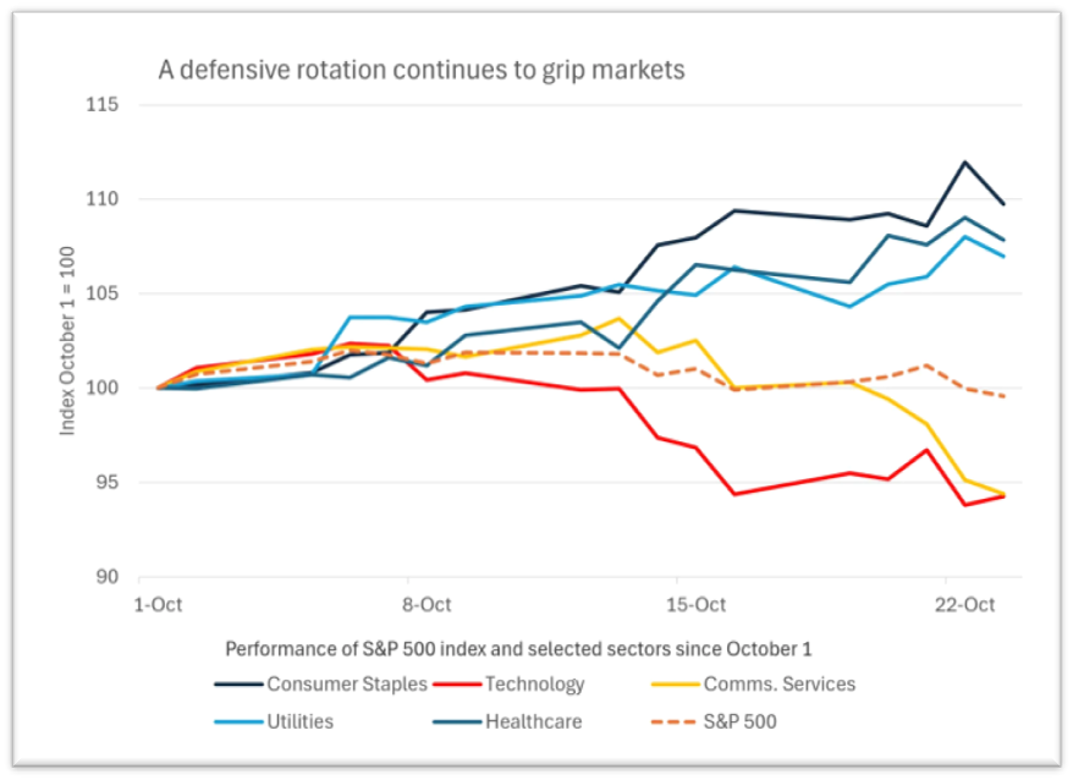
Source: Bloomberg
Meta Platforms was among the notable decliners, as investors focused on the company's substantial capital spending plans and potential financing needs, despite favourable AI-related demand. It is not alone as other technology companies have also faced heightened scrutiny, as investors assessed whether earnings growth could justify elevated valuations and continued high infrastructure investment.
In the large-cap universe, value stocks outpaced growth for the third consecutive week. Oil prices moved higher late last week amid reports of renewed tensions in the Middle East, which reversed earlier declines tied to optimism surrounding U.S.-Iran diplomatic discussions. U.S. Treasury yields (bond prices and yields move in opposite directions) decreased sharply during last week. The benchmark 10-year Treasury yield fell below five per cent for the first time in about a month last Thursday and was about 4.99 per cent by Friday afternoon.
The pan-European STOXX Europe 600 Index ended last week down 1.39 per cent in local currency terms. Investor sentiment across European markets was dampened by soaring oil prices and Middle East tensions, heightened inflationary pressures, and domestic political unrest, particularly in France. Other major European stock markets also ended down last week.
Japan’s stock markets lost ground over the week due to investor reassessment of the outlook for AI investment, which questioned how data centre spending will be financed and whether it can be sustained. Higher oil prices and Middle East tensions added to investor caution. The yield on the 10-year Japanese government bond (JGB) fell to 2.78 per cent from 2.94 per cent at the end of the previous week. Japanese bond prices rose last week, as investors moved into lower-risk assets after the global equity sell-off, which also contributed to a rally in U.S. government bonds.
Chinese stock markets on the mainland declined last week, despite a Friday rebound which pared some losses following a technology-led sell-off. AI-linked shares weakened amid concerns over investment spending, financing requirements, and corporate earnings, while losses in U.S. technology stocks and higher oil prices added to market volatility.
China's gross domestic product (GDP) grew 4.5 per cent year on year in the third quarter, up from 4.3 per cent in the second quarter and ahead of the 4.4 per cent median forecast in a Reuters poll. According to the National Bureau of Statistics, September industrial production rose 5.5 per cent year on year, and retail sales increased 1.1 per cent, while fixed asset investment (excluding rural households) fell 7.2 per cent over the first nine months compared with a year earlier. GDP increased 4.6 per cent year on year in the first three quarters, leaving the government's 4.5 per cent to 5.0 per cent annual growth target within reach. The stronger headline GDP reading may reduce the urgency for broad-based stimulus, although subdued consumption and weak investment point to uneven domestic demand. (4)
Cleverfolks: How fast has Tech advanced in the last 10 Years? Medium, September 8, 2025
How Market Headlines Influence Investment Decisions, Cardinal Capital Management, educatedinvestors.ca
TSX extends weekly decline as financials, consumer-related shares fall, Reuters, October 23, 2026
Global Markets Weekly Update - AI investment concerns and rising oil prices drive volatility across markets, T. Rowe Price, October 2026
The opinions expressed are those of Craig Swistun and not necessarily those of Raymond James Investment Counsel which is a subsidiary of Raymond James Ltd. Statistics and factual data and other information presented are from sources believed to be reliable, but their accuracy cannot be guaranteed. It is furnished on the basis and understanding that Raymond James is to be under no liability whatsoever in respect thereof. It is for information purposes only and is not to be construed as an offer or solicitation for the sale or purchase of securities. Raymond James advisors are not tax advisors, and we recommend that clients seek independent advice from a professional advisor on tax-related matters.
SUBSCRIBE
If you’d like to automatically receive the Weekly Market Update by email, enter your email address in the box below.
We respect your privacy, and you can always remove yourself from the mailing at any time.
Looking to Learn?
If you want to know more about some of the topics we wrote about this week, just click on the links below:
Impact of News on Stock Prices: Understanding Market Reactions
