
“Good communication is just as stimulating as black coffee, and just as hard to sleep after.”
ISSUE 250
Looking Around
250 Weeks Later…
And we are still collecting our thoughts and sharing them with you through our Weekly Market Update. Our first edition was published on September 13, 2021 – more than five years ago. Since then, we’ve averaged roughly 48 updates each year, as everyone needs the occasional vacation.
Recently, we went back and read some of those early editions. Maybe we were looking for evidence that our thinking had evolved. Or, perhaps, we were simply curious about how we talked about what was happening in the world at the time. Unsurprisingly, we found that the headlines were familiar: rising inflation, slower wage growth, and lingering concerns about geopolitical events like COVID-19. What struck us the most was not what we wrote about, but what we had forgotten since then.
As you may know, we sit down every week (except when on vacation) and write these updates from scratch. At the time, the events we discuss often feel enormously significant. Yet years later, many have faded from view and, more importantly, from memory. The market mover of the week, a closely watched economic release, or a forecast that appeared particularly persuasive at the time has often faded into history. What remains is something less tangible, but ultimately more meaningful.
Taken together, these 250 updates form a record of how investors experienced, interpreted, and navigated uncertainty. They also serve as a record of the role we have attempted to play throughout that process: providing context, perspective, and a steady hand when markets felt anything but steady. For us, these weekly updates matter. They help separate temporary, short-term market volatility from structural or macroeconomic shifts and are part of our communication commitment to our clients.
All of that said, today, the headlines may be different, but the way investors react to them is achingly familiar.
In September 2022, we wrote: “For many, getting in the car in the summer and going for a drive was a relaxing way to spend an afternoon. But when gas prices were hovering around $2 per litre, this simple pleasure became a lot more expensive.” Who remembers gas at $2/litre from 2022? At the time, it was a major issue. Today, it’s an interesting historical footnote.
Each era tends to regard its uncertainties as unique. And it is easy to believe that the present moment is unlike any that came before it because, in important ways, it is. Five years ago, we were not talking about generative artificial intelligence, and the Strait of Hormuz was largely absent from market discussions. During the past several years alone, investors have navigated a global pandemic, the return of inflation, the most aggressive interest-rate tightening cycle in a generation, banking stresses, and wars in both Europe and the Middle East.
Along the way, there was no shortage of predictions about what must surely happen next.
Many of those predictions were made with remarkable confidence.
But a surprising number were wrong.
With time and experience, we have become less interested in certainty and more interested in perspective. Shakespeare captured this idea more elegantly than any economist could in his play, Hamlet, when Hamlet reminds Horatio that, “There are more things in heaven and earth, Horatio, than are dreamt of in your philosophy.” Markets have a habit of reminding us of the same. Just when we become convinced that we understand the forces shaping the future, events emerge that expose the limits of our understanding.
It is one of the reasons we appreciate the craft of portfolio management more deeply over time. Research, education, analysis, and hard work all matter. Yet the longer we have spent in this profession, the more we have come to appreciate that successful investing depends just as heavily on preparation for outcomes we cannot foresee. No matter how sophisticated our investment models become, the future has always resisted attempts to be reduced to a mere spreadsheet or forecast.
However, navigating uncertainty does not require us to know what will happen next. It requires us to acknowledge that we might not know. That distinction may seem subtle, but it changes everything. Once uncertainty is accepted as a permanent feature of investing rather than a temporary inconvenience, focus naturally shifts. It shifts away from prediction and toward process, away from forecasting every twist and turn and toward building portfolios capable of enduring roads that have yet to be imagined. Looking back across these years of commentary, we have found that discipline is among the most underrated qualities in investing.
Discipline is not a particularly glamorous quality. It lacks the allure of innovation and draws far less attention than insight. Yet, over time, we have learned that it is one of the most valuable attributes an investor can possess. Markets may periodically reward boldness, but they almost always reward disciplined patience during bubbles and market volatility. There is no shortage of examples of bubbles in history where investors have repeatedly convinced themselves that this time was different and that old rules no longer applied:
· The tulip mania of 17th-century Holland, which was the first recorded speculative economic bubble.
· The South Sea Bubble which was the world’s first Ponzi scheme.
· The Roaring Twenties that led to the Great Depression.
· The Dotcom Bubble that was one of the most dramatic market booms and busts in modern history.
· The United States housing bubble, which sparked the 2008 Global Financial Crisis.
In all of the above, the cast of characters changes, but human nature does not. This is central to remaining disciplined. Investment management is not just about numbers where risk and assets become abstract, performance becomes percentages and discussion centres on returns, volatility, and benchmarks. The reason for this is that, in reality, every portfolio tells a human story, and this has been embedded in our approach from the beginning. One of our founding principles was that we would write in plain language and attempt to demystify the often impenetrable vocabulary of financial markets. Behind every account is a purpose. Sometimes, it is a retirement or family. Other times, it is a charitable organization seeking to advance a mission that will outlive its current leadership. This is not to say that the numbers don’t matter. They do because the investment objectives matter.
Re-reading years of commentary has produced an unexpected benefit – it has created a record of investor concerns. Looking through those old updates, it is striking how many once-pressing worries have disappeared entirely from the conversation. This illustrates how temporary concerns often feel permanent while we are living through them but, like everything else, they eventually pass.
Publishing these weekly updates has increasingly shaped our thinking, particularly through our work with charities and nonprofit organizations. Markets may generate capital growth, but stewardship determines whether that growth creates lasting impact. Over time, conversations tend to become less about accumulation and more about responsibility. Perhaps that is another lesson hidden within 250 weeks of observations. Time has a remarkable ability to reveal what truly matters.
Events that dominate investor attention come and go, but principles endure longer than insights. Character endures longer than forecasts. A thoughtful process endures longer than any particular market narrative.
When we published the first Weekly Market Update, our objective was relatively modest. We wanted to help clients understand what was happening in the markets and provide perspective during periods of uncertainty. Looking back, we hope that these updates also served a slightly different purpose. We hope that they remind our clients that, although markets will always provide reasons for concern and claims that “this time is different,” our role remains the same. We are not in the business of predicting the future. Rather, we are in the business of helping our clients prepare for it.
If there is a common thread running through these 250 weeks of commentary, it is that thoughtful investing has never depended upon certainty. It depends upon discipline, patience, and a clear understanding of what we are trying to accomplish in the first place.
The headlines will continue to change. These principles, we believe, will not.
Read and Watch
Want deeper insight into topics in your Weekly Update? Then, read and/or right click:
A Bank of Canada rate hike could still land in 2026, say economists after inflation reading
US stocks drop to their worst day since July as inflation worsens
European majors set for Q3 earnings growth despite darkening view on consumer cyclicals
Japan’s tightening path meets fiscal pressure
China economy grows thanks to AI export boom but domestic slump remains a drag
Looking Back
The Toronto Stock Exchange's S&P/TSX Composite Index (TSX) ended up last week. In contrast, most stock markets in the United States (U.S.) ended the week on a down note as a tech selloff deepened and oil prices climbed last Friday. Boosted by oil stocks, the TSX gained 0.11 per cent on Friday, thereby touching its highest level since September 4. For the week, the TSX was up 1.44 per cent, as energy stocks rose 2.8 per cent and Brent oil reached $110 a barrel for the first time since May, thanks to ongoing worries that escalating tensions in the Middle East could tighten supplies further. According to Josh Sheluk, CIO at Verecan Capital Management, the TSX currently offers an interesting diversifying investment relative to global stocks because it is a lot more heavily allocated and weighted towards not only energy but materials as well.
Although technology stocks fell 3.5 per cent last week, the artificial intelligence (AI) trade appears to have affected the TSX to a significantly lesser extent than U.S. markets. Meanwhile, investors appear to be assessing Bank of Canada (BoC) Governor Tiff Macklem's warning on persistent energy-price pressures on interest rates. The BoC is not expected to raise interest rates at its next monetary policy decision announcement on October 28, but money markets are pricing in a rate hike of 25 basis points in December. (1)
Most major U.S. stock indexes ended last week lower due to a sharp sell-off in artificial intelligence (AI)-related stocks, hotter-than-expected inflation data, and the start of third-quarter earnings season, which drove a rotation away from large-cap growth stocks and into more value-oriented and defensive segments of the market. The technology-heavy Nasdaq Composite fared the worst – down by 4.48 per cent while the Dow Jones Industrial Average added 0.67 per cent. Concerns about the sustainability of AI-related investment appeared to be a major driver of last week's sentiment, with semiconductor and memory stocks facing selling pressure amid heightened scrutiny of financing needs, valuations, and potential returns on AI infrastructure spending. Meanwhile, escalating tensions in the Middle East supported oil prices that provided a tailwind for the energy sector.
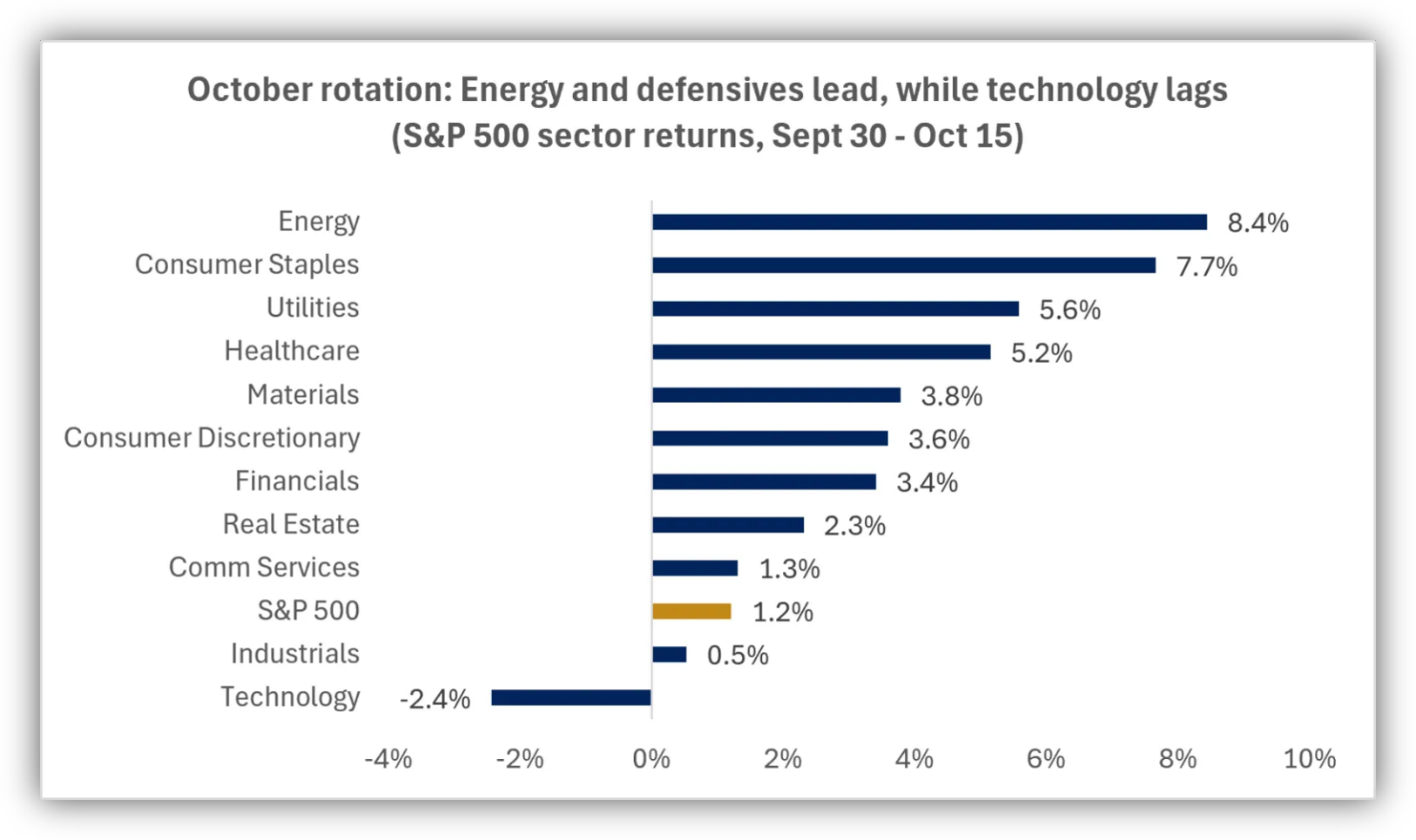
Source: Bloomberg. S&P 500 sector returns, Sept 30 - Oct 15, 2026.
News about rising inflation in the U.S. did not help either. The Bureau of Labor Statistics reported last week that its consumer price index (CPI) rose 3.7 per cent year over year in September, which was slightly above consensus estimates for a 3.6 per cent increase and up from the prior month’s 3.4 per cent rise. Core CPI, which excludes food and energy costs, rose 2.6 per cent year over year. On a month-over-month basis, gasoline prices rose 9.1 per cent, which accounted for more than half of the headline index’s increase.
Comments by U.S. Federal Reserve (Fed) Chair Kevin Warsh provided little clarity on what Fed policymakers will decide at their upcoming October meeting. Data from the CME FedWatch Tool last Friday showed a roughly 17 per cent probability of a rate hike at the meeting despite hotter-than-expected inflation. Last week, U.S. Treasuries advanced as the sharp sell-off in technology stocks appeared to fuel demand for government bonds, particularly longer-dated Treasuries. The yield on the benchmark 10-year U.S. Treasury note dropped to around 5.09 per cent last Friday from about 5.24 per cent at the end of the prior week.
The pan-European STOXX Europe 600 Index advanced 2.09 per cent in local currency terms last week, as the European earnings reporting season got underway, which shifted investors’ attention back to corporate fundamentals. Middle East tensions and energy prices remained a major market driver. Other major European stock markets all rose last week. However, Eurozone inflation remains elevated, which could lead to concerns of higher interest rates.
Japanese stocks fell last week, which was a holiday-shortened week, with markets closed on Monday. Higher-than-expected U.S. inflation revived concerns about the outlook for interest rates and elevated valuations, while growing scrutiny of the substantial borrowing required to finance AI infrastructure investment impacted sentiment negatively. Elevated oil prices and geopolitical uncertainty, particularly surrounding the ongoing conflict in the Middle East and risks to energy supplies, added to investor caution. Concerns over Japan’s fiscal outlook, persistently high bond yields, yen weakness, and rising oil prices amid renewed Middle East tensions also weighed on sentiment.
In mainland China, stock markets declined last week, as selling in previously strong semiconductor and other AI-related shares weighed on benchmarks. This weakness also coincided with renewed concerns about the scale and potential returns of AI-related spending and stronger-than-expected U.S. inflation, which revived worries about higher interest rates. Overall, financial shares generally held up better than technology stocks, which led losses amid elevated global bond yields, higher oil prices, and renewed concerns over potential U.S. restrictions on Chinese optical communications products. (2)
TSX rises as oil stocks gain on Brent touching $110 a barrel, Reuters, October 16, 2026
Global Markets Weekly Update - AI spending worries and inflation pressures drive sentiment across global markets, T. Rowe Price, October 2026
The opinions expressed are those of Craig Swistun and not necessarily those of Raymond James Investment Counsel which is a subsidiary of Raymond James Ltd. Statistics and factual data and other information presented are from sources believed to be reliable, but their accuracy cannot be guaranteed. It is furnished on the basis and understanding that Raymond James is to be under no liability whatsoever in respect thereof. It is for information purposes only and is not to be construed as an offer or solicitation for the sale or purchase of securities. Raymond James advisors are not tax advisors, and we recommend that clients seek independent advice from a professional advisor on tax-related matters.
SUBSCRIBE
If you’d like to automatically receive the Weekly Market Update by email, enter your email address in the box below.
We respect your privacy, and you can always remove yourself from the mailing at any time.
Looking to Learn?
If you want to know more about some of the topics we wrote about this week, just click on the links below:
The Impact of War on the Stock Markets—What Investors Need To Know
How does the stock market perform during midterm election years?
