
Lexicon Financial Group Weekly Update — October 14, 2026
“If you’re going to invest in stocks for the long term, or real estate, of course, there are going to be periods when there’s a lot of agony and other periods when there’s a boom. I think you just have to learn to live through them.”
ISSUE 249
Looking Around
“Like it or not, we live in interesting times. They are times of danger and uncertainty.” This phrase was part of a speech delivered by Robert Kennedy in South Africa in 1966. (1)
And, given the current state of the world, this phrase is every bit as relevant today as it was 60 years ago. We are certainly living through interesting times, but it is worth remembering that this is nothing new. History has a way of rhyming, and periods of uncertainty eventually pass. This applies to life in general and to equity markets as well.
Right now, stock markets are volatile but remain positive year to date. Despite geopolitical tensions, the S&P 500 sits near record highs, suggesting investors remain optimistic about economic growth, corporate profits, and the future. However, beneath the surface, market leadership has narrowed dramatically, participation is deteriorating and an increasing number of companies are already in bear market territory. Roughly 60 per cent of S&P 500 constituents were down more than 20 per cent from their individual highs in the first week of October.
Weak market breadth has occurred before: during the 1973-74 bear market and at the peak of the technology bubble in 1999-2000. Increasingly, this is no longer a broad-based bull market. Rather, it is a market being carried by a remarkably small group of companies tied to artificial intelligence (AI). That concentration alone does not guarantee trouble ahead, but it does increase vulnerability if expectations fail to match reality. This concern has only grown, as discussion around a potential AI bubble has become more widespread.
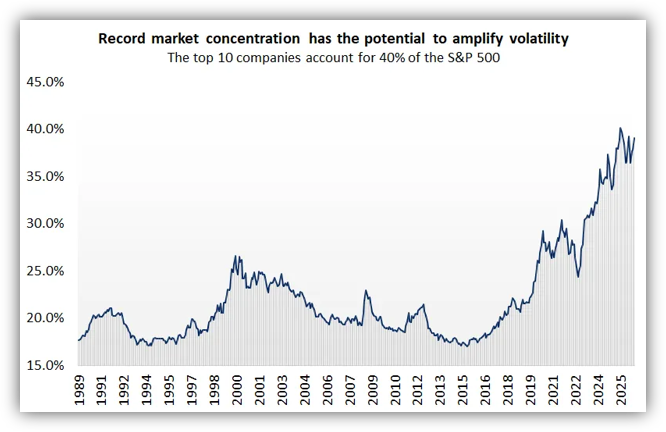
Source: Factset
The dilemma is that building the AI infrastructure of the future requires enormous investment in data centres, semiconductor manufacturing, power generation, and transmission networks. According to a recent Brookings Institution study, financing the AI buildout could total an extraordinary US$10.3 trillion between 2025 and 2032.
Investors remain focused on AI growth projections, but bond markets are increasingly focused on a different question: who will finance both the AI buildout and Washington's borrowing needs? Bond investors are demanding greater compensation for holding long-dated bonds, the administration is pushing for lower rates. That’s a conflict that markets have a history of resolving.
Rising bond market volatility does not automatically signal an imminent bear market. Historically, stocks have continued to advance for weeks, months, and, in some cases, more than a year after fixed-income investors first became concerned. However, when bond markets and equity markets disagree for an extended period, one of them is eventually forced to adjust.
Higher bond yields create challenges not only for governments but also for the companies leading the AI boom. As borrowing costs rise, financing large-scale infrastructure projects becomes more expensive. Over time, higher capital costs could become a meaningful headwind for both corporations and governments.
Sadly, some of this pressure may have been avoidable. The U.S.-Iran war that began earlier this year has contributed to higher energy prices and renewed inflation concerns at precisely the wrong moment for an economy that was already showing signs of slowing outside of AI-related spending. (2)
Remember, the classic mechanism for fighting inflation is higher interest rates.
The nature of equity markets is to move up and down over time. For long-term investors, remaining invested during periods of market stress is generally the best course of action. A market decline is not necessarily a reason to abandon a long-term investment strategy or sell quality investments.
Investment decisions should always be guided by your time horizon, cash-flow needs, risk tolerance, and financial goals. More importantly, a well-designed plan can help prevent emotional decision-making and keep you focused on what matters most: achieving your long-term objectives. (3)
Read and Watch
Want deeper insight into topics in your Weekly Update? Then, read and/or right click:
Rising bond yields, softer labour data buy central banks time
US inflation rises before midterm elections, fuelling rate hike fears
European stocks eke out weekly gain as oil, yields ease; SpaceX spectrum deal hits telecoms
Japan economy minister stresses BOJ independence, rejects reflationist label
Looking Back
Last week, the Toronto Stock Exchange's S&P/TSX Composite Index (TSX) bounced back to post its biggest gain since early September. On Friday, led by gains for Aritzia and metal mining shares as well as weaker-than-expected domestic jobs data, which reduced expectations for Bank of Canada (BoC) interest rate hikes, the TSX rose 1.48 per cent. For the week, the index added 0.46 per cent after two straight weeks of declines. Canada's economy shed 68,300 jobs in September and the unemployment rate edged up to 6.5 per cent. Analysts had forecasted a jobs gain of 9,200.
As a result, investors saw a 25 per cent chance the BoC would hike at the October 28 policy announcement, which is down from 40 per cent before the jobs report. (4)
Last week, major U.S. stock indexes, once again, finished the week mixed due to volatility in artificial intelligence (AI)-related stocks, developments in the Middle East, and sharp moves in energy prices and Treasury yields. The S&P 500 Index rose 1.15 per cent, while the Dow Jones Industrial Average and Nasdaq Composite added 0.93 per cent and 0.64 per cent, respectively. At the sector level, consumer staples, utilities, and energy led performance, while industrials and information technology stocks declined.
Minutes from the Fed’s September policy meeting—where officials unanimously voted to raise interest rates by 25 basis points (0.25 percentage points)—showed that most policymakers anticipated another rate increase by year-end amid persistent inflation pressures.
The pan-European STOXX Europe 600 Index ended last week slightly up by 0.03 per cent in local currency terms. European equities were volatile as renewed Middle East tensions, a more hawkish European Central Bank (ECB) backdrop, mixed eurozone industrial data, and softer UK activity indicators shaped investor sentiment during last week. Other major European stock indexes all moved lower last week.
Japan’s stock markets gained over last week, as equities rallied strongly early in the period, led by AI- and semiconductor-related shares, as recent weaker-than-expected U.S. employment data reduced expectations for a near-term Fed rate hike and lifted global technology stocks. Those gains were partially reversed later in the week, as investors reassessed AI-related valuations and growth expectations. Concerns over Japan’s fiscal outlook, persistently high bond yields, yen weakness, and rising oil prices amid renewed Middle East tensions also weighed on sentiment.
Chinese stock markets ended last week mixed. Technology stocks led losses amid elevated global bond yields, higher oil prices, and renewed concerns over potential U.S. restrictions on Chinese optical communications products. In Hong Kong, energy shares benefited from higher oil prices earlier in the week, while a sharp rebound in internet and technology stocks on Friday, alongside easing oil prices, helped upward momentum. (5)
Robert Kennedy 1925–68, American Democratic politician, Susan Ratcliffe, Oxford Essential Quotations, 2017
The hidden warning beneath record stock market highs, Martin Pelletier, Financial Post, October 5, 2026
Should You Invest During a Market Downturn? Ryan A. Hughes, Bull Oak, September 4, 2026
TSX posts biggest gain in five weeks as rate hike bets recede, Fergal Smith, Reuters, October 9, 2026
Oil prices volatile amid escalating Middle East tensions, T. Rowe Price, October 2026
The opinions expressed are those of Craig Swistun and not necessarily those of Raymond James Investment Counsel which is a subsidiary of Raymond James Ltd. Statistics and factual data and other information presented are from sources believed to be reliable, but their accuracy cannot be guaranteed. It is furnished on the basis and understanding that Raymond James is to be under no liability whatsoever in respect thereof. It is for information purposes only and is not to be construed as an offer or solicitation for the sale or purchase of securities. Raymond James advisors are not tax advisors, and we recommend that clients seek independent advice from a professional advisor on tax-related matters.
SUBSCRIBE
If you’d like to automatically receive the Weekly Market Update by email, enter your email address in the box below.
We respect your privacy, and you can always remove yourself from the mailing at any time.
Looking to Learn?
If you want to know more about some of the topics we wrote about this week, just click on the links below:
Is there an AI bubble? No, but some tech companies show signs
