
“Bull markets are born on pessimism, grow on skepticism, mature on optimism and die on euphoria.”
Issue 254
There’s an old SCTV bit where Rick Moranis plays George Carlin commenting on how escalators go up and go down, but they never go sideways. Except they do. And so do markets.
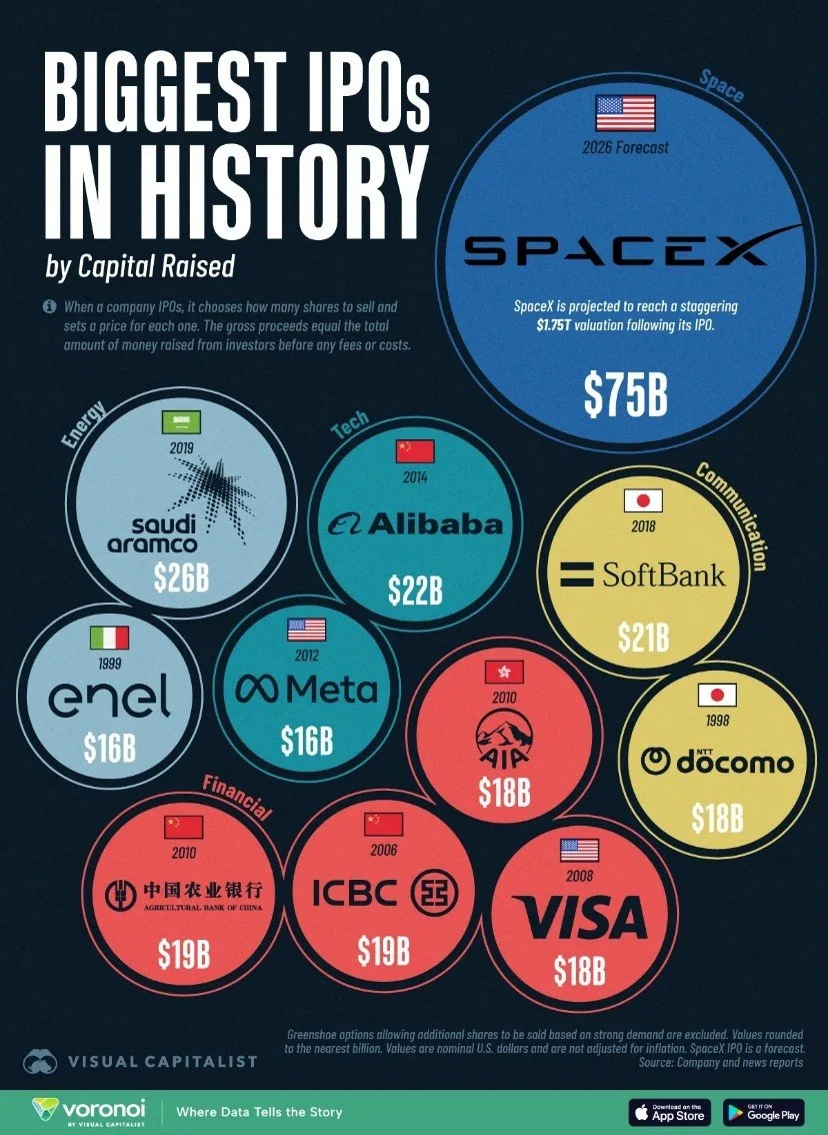
Up, down, up, down. That is how global stock markets have moved since the largest initial public offering (IPO) ever, Anthropic, last week.
Remember wooden roller coasters? Remember the mixed feeling of relief and queasiness when the ride ended? That’s how markets made investors feel over the last 10 days.
But why are these gyrations happening?
First, it helps to know where we are. Are we in a bull market where stock prices are rising or a bear market where they are falling? Financial media often defines a bull market as starting when a stock market rises 20 per cent or more from a bottom for a sustained period of time. A new bear market begins when a stock market declines 20 per cent or more away from its peak or trough. Bear markets usually have four distinct phases:
Phase 1 is characterized by high prices and high investor sentiment that is followed by investors beginning to move out of the markets and take in profits.
In Phase 2, stock prices begin to fall sharply, and trading activity and corporate profits start to drop, while economic indicators that may have once been positive start to become below average. Some investors begin to panic as sentiment starts to fall. This is often referred to as capitulation.
During Phase 3, speculators start to enter the market, which raises some stock prices and trading volume.
Phase 4 (and last phase) sees stock prices continue to drop, but slowly. As low prices and good news start to attract investors again, bear markets can start to lead to bull markets.
But knowing for certain whether we are in a bull or bear market can only be done with 100 per cent accuracy in hindsight because stock market behaviour is impacted and determined by how individuals perceive things at any given moment. In many ways, the market is essentially a barometer of human behaviour, which is why the study of behavioural finance is so interesting.
Stock market performance and investor psychology are mutually dependent. For example, during a bear market, market sentiment is negative, as investors begin to move their money out of equities and into fixed-income securities and wait for a positive move in the stock market. In sum, the decline in stock market prices shakes investor confidence, which causes investors to keep their money out of the market—which, in turn, causes a general price decline as outflow increases.
Conversely, in a bull market, investors willingly participate in the hope of obtaining a profit. And they have done so since the start of the current bull market in the United States (U.S.) in October 2022. This is despite periods of market volatility and the impact of geopolitical events such as the war in Ukraine and conflict in the Middle East. (1)
The chart below provides a longer-term view of bull and bear markets since 1980.
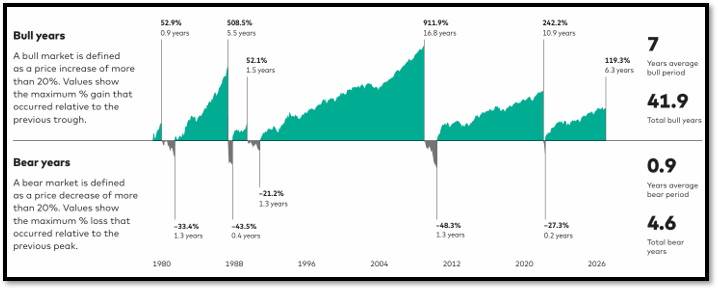
As you can see, bull markets often last longer than bear markets, which makes sense since stock prices tend to trend upward over time. In fact, there have been 26 bear markets and 26 bull markets since 1872, according to a recent report from Fidelity Investments. Bear markets lasted a median of 19 months (less than two years), with a median drop of -33 per cent and durations ranging from 1 month to 113 months (nearly 9.5 years). Bull markets lasted a median of 42 months (3.5 years), with a median spike of 87 per cent and durations ranging from 14 months to 98 months (about eight years).
Also, bull markets tend to coincide with a robust economy where there is low unemployment, increasing wages, healthy levels of consumer spending and production, and moderate inflation. However, it’s difficult to determine if the economic benefits are the reason for or the result of the bull market. A good economy can also drive investments in the stock market, which in turn can boost the economy. It’s a machine that feeds on itself. Positive or negative news reinforces the prevailing sentiment for the market until something radical happens to change that. Which is what we said in 2020 when COVID 19 emerged.
Similarly, bear markets tend to coincide with a down economy. When unemployment rises and consumer spending falls, companies may seem less attractive to investors, which may lead stock prices to fall into bear market territory. But it’s not easy to claim the economic downturn poked the bear market, or that the bear market spurred the economic slowdown. History shows that in about a quarter of bear markets, recessions haven’t happened. (2)
All economic indicators continue to suggest that we’re still in a good place for the markets, despite recent pullbacks. Anthropic doesn’t become the largest IPO in history without investor sentiment pushing it forward. There is still plenty of momentum behind technology and AI investments. But, it is not unusual to have periodic pullbacks during a bull market – there have been several since the beginning of 2025. Staying in the market over time and remaining diversified continue to be tried-and-true methods for generating good results over time.
Are We in a Bull Market or a Bear Market? Alan Farley, Investopedia, October 23, 2026
Bear vs. bull market – Fidelity, September 1, 2026
The opinions expressed are those of Craig Swistun and Wayne Hendry and not necessarily those of Raymond James Investment Counsel which is a subsidiary of Raymond James Ltd. Statistics and factual data, and other information presented are from sources believed to be reliable, but their accuracy cannot be guaranteed. It is furnished on the basis and understanding that Raymond James is to be under no liability whatsoever in respect thereof. It is for information purposes only and is not to be construed as an offer or solicitation for the sale or purchase of securities. Raymond James advisors are not tax advisors, and we recommend that clients seek independent advice from a professional advisor on tax-related matters. RJIC is not responsible for the availability or content of external websites, nor does it endorse, warrant, or guarantee the products, services, or information described therein.
SUBSCRIBE
If you’d like to automatically receive the Weekly Market Update by email, enter your email address in the box below.
We respect your privacy, and you can always remove yourself from the mailing at any time.
Looking to Learn?
If you want to know more about some of the topics we wrote about this week, just click on the links below:
Anthropic Just Went Public. Here's What Happens to Most IPO Stocks in the First Week
