
“The way to bring gas prices down is to end our dependence on oil and use the renewable sources that can give us the equivalent of $1 per gallon gasoline.”
It was only a few short weeks ago that consumers in Southern Ontario saw gas prices approaching $2/litre. So, the most recent drop in gas prices may have provided some relief to commuters. The price of regular gas in Toronto today was 147.9¢/L – the lowest level in more than eight months. Key reasons for this drop are:
Recovering Middle East Shipments: According to the International Energy Agency (IEA), the global oil market will return to a surplus in the fourth quarter of this year, as exports from the Middle East recover faster than global oil demand despite continued attacks on shipping. Oil supply will average 105 million barrels per day (bpd) in the fourth quarter of 2026. This is 1.7 million bpd higher than forecast demand. The IEA had previously forecast a fourth-quarter supply deficit. Traders now appear to be, for the first time since the Iran conflict began, actively contemplating the possibility of excess supply rather than persistent tightness.
U.S. Policy: Prices were also pressured down by President Trump’s decision to extend by 90 days a waiver of the Jones Act, which requires U.S.-flagged ships to carry cargo between U.S. ports. This will continue to allow foreign-flagged ships to transport domestic oil and fuels such as gasoline and diesel more easily between U.S. ports.
Softening Demand Signals: Signs of cooling demand in major consuming nations like China have also put downward pressure on the market. The latest data from China's National Bureau of Statistics this week showed that refinery throughput for October fell two per cent from a month earlier and was down 8.1 per cent from a year ago. (1)
Also, with the Democrats winning control of both the House of Representatives and the Senate, it is expected that they will challenge President Donald Trump's handling of the U.S.-Israel war with Iran. So, it came as no surprise that this outcome almost immediately drove global oil prices lower. (2)
However, oil and retail gas prices are still higher than they were in January this year. And the insecurity around the reliable oil supplies is not going away anytime soon. With so many moving parts, it’s no wonder consumers can’t make heads or tails of price movements.
Price volatility (changes in price) has increased the focus on alternative and renewable sources of energy. Countries around the world are embracing clean power and taking steps to use less energy due to the impact of the war against Iran. Yet global investment in wind and solar deployment fell in the first half of 2026 compared to the same period last year, according to Rhodium Group’s Clean Investment Monitor. China accounted for most of this decline but in the U.S., Europe and India, where economies are more exposed to gas and oil prices, solar investment grew and wind investment grew or held stable.
According to the IEA, 33 governments (including the Netherlands, Spain and the United Kingdom) adopted policies to switch from fossil fuels to electricity and/or improve energy efficiency. This includes supporting EV adoption, promoting renewable energy, replacing gas boilers with electric heat pumps and retrofitting homes and businesses to use less energy. China is working to make heavy industry more energy efficient and pushing to electrify heavy vehicles. India and Indonesia are shifting to electric stoves to replace imported liquefied natural gas (LNG) as a cooking fuel. Laos suspended gas and diesel car imports through 2026 to boost electric vehicles (EVs).
There are substantial benefits to doing this switch. Fossil fuel importers have paid prices that are U$330 billion higher compared to pre-war market expectations. This is the largest sustained price shock since the 1990 Gulf War, according to research by the Centre for Research on Energy and Clean Air. And the European Union, China and India paid the most. Countries that invested in clean energy after past energy crises saved an estimated U$36 billion in avoided fossil fuel imports in the first five months of the conflict.
Brookings Institution scholar Samantha Gross contends that the Iran war is changing how people think about transitioning away from fossil fuels. It is not just about the climate; it’s about energy security. (3)
Oil investment is expected to decline for a third consecutive year in 2026, falling below U$500 billion. At the same time, natural gas investment is projected to rise to U$330 billion, the highest level in a decade, supported by a wave of new LNG export projects, particularly in the United States and Qatar.
A quiet shift just might be getting louder.
There is growing interest among fuel-importing countries in developing domestic energy sources that include renewables, nuclear power and, in some cases, coal. Investment in renewable power projects is expected to total around U$665 billion in 2026, with U$365 billion going toward solar alone.
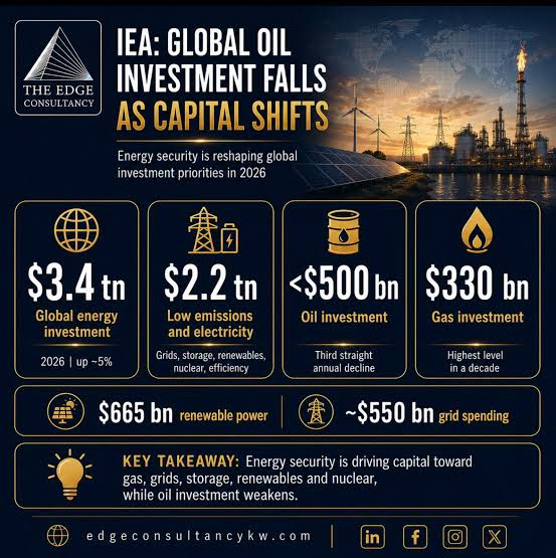
While annual investment growth in renewables has moderated, following several years of rapid expansion, low-emissions sources still account for more than 70 per cent of total power generation investment globally. Nuclear investment is continuing its resurgence, exceeding $80 billion annually, with close to 80 gigawatts of new nuclear capacity under construction across 15 countries. (4)
Changes like this present investors with opportunities, which may also come with certain risks. According to the U.S. Department of Energy, renewable electricity used to power an electric vehicle (EV) now reliably delivers the driving equivalent of U$1 per gallon gasoline. There is no other liquid or gaseous biofuel sold at retail pumps that currently comes close to this, but that may change. The trick here is to be ready for it.
Oil settles lower as recovering Middle East exports bolster surplus outlook, Arathy Somasekhar, Reuters, November 16, 2026
Oil prices are in freefall now that the Democratic sweep is ‘rewriting the Iran playbook’, Myra P. Saefong, MarketWatch via Yahoo! Finance, November 4, 2026
The Iran war is driving clean energy development. It’s not enough to help the planet, yet Jennifer McDermott, Associated Press, September 17, 2026
Impacts of Middle East conflict set to reshape energy investment plans as disruptions put focus on security, International Energy Agency, May 28, 2026
The opinions expressed are those of Craig Swistun and Wayne Hendry and not necessarily those of Raymond James Investment Counsel which is a subsidiary of Raymond James Ltd. Statistics and factual data, and other information presented are from sources believed to be reliable, but their accuracy cannot be guaranteed. It is furnished on the basis and understanding that Raymond James is to be under no liability whatsoever in respect thereof. It is for information purposes only and is not to be construed as an offer or solicitation for the sale or purchase of securities. Raymond James advisors are not tax advisors, and we recommend that clients seek independent advice from a professional advisor on tax-related matters. RJIC is not responsible for the availability or content of external websites, nor does it endorse, warrant, or guarantee the products, services, or information described therein.
SUBSCRIBE
If you’d like to automatically receive the Weekly Market Update by email, enter your email address in the box below.
We respect your privacy, and you can always remove yourself from the mailing at any time.
Looking to Learn?
If you want to know more about some of the topics we wrote about this week, just click on the links below:
Oil, gas, and diesel prices are declining — but not all for the same reason
The Commodities Feed: Oil plunges following US midterm elections
