
Lexicon Financial Group Weekly Update — May 20, 2026
“Inflation destroys savings, impedes planning, and discourages investment. That means less productivity and a lower standard of living.”
From the desk of Craig Swistun, CIM, MFA-P, Portfolio Manager, Raymond James Investment Counsel, and Wayne Hendry, Client Relationship Manager, Raymond James Investment Counsel
ISSUE 229
Looking Around
If you have ever had a garden and tried to grow a specific plant, you know that weeds are a scourge. According to Wild Pollinator Partners, weeds aggressively compete for critical resources like sunlight, water, and soil nutrients. In Canada, where the growing season is short, getting gardens to grow the plants we want is a never-ending battle against weeds.
You can think of global economies as gardens; they have their own economic weed – inflation. When the price of goods and services rise, money doesn’t go as far as it once did. High inflation is often unstable and unpredictable, leads to underperforming economies, and impacts standards of living.
The global energy price spike due to the Middle East conflict has driven inflation up across the world. Central banks often use two per cent as a policy target, so anything above that number is considered higher-than-desired. Other countries have had different reactions. In Japan, for example, inflation isn’t as pronounced, as the government rolled out measures to reduce tax on fuel. (1) Other countries are considering a similar tax reduction, which would reduce inflation and the impact of higher costs on consumers.
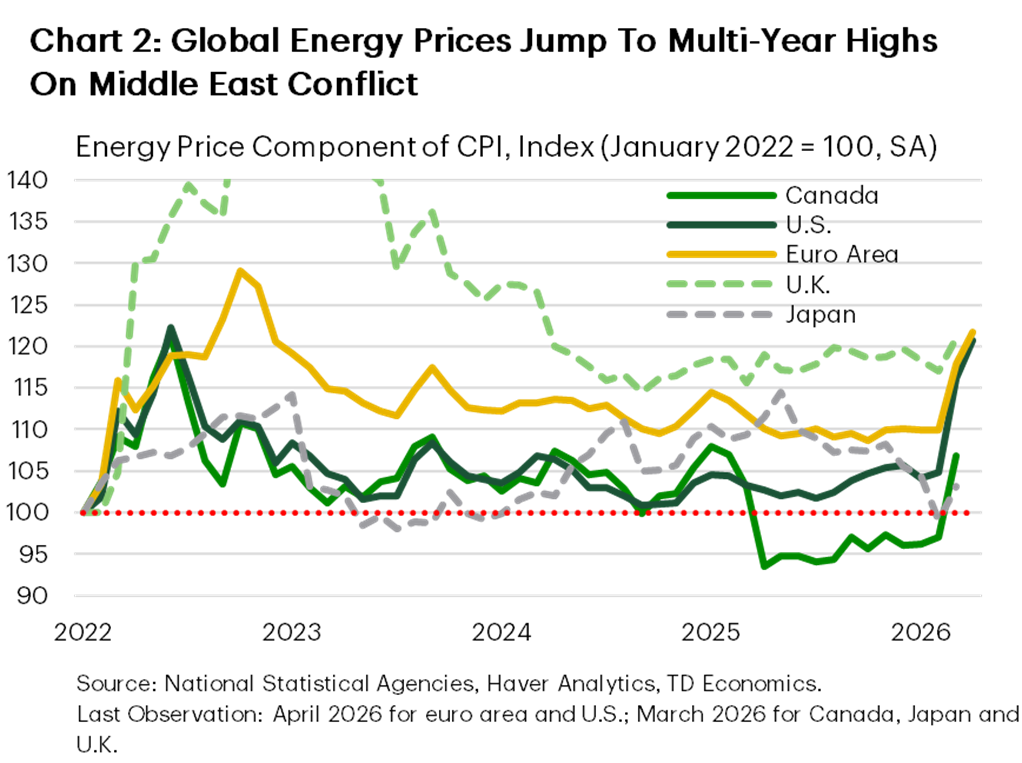
Here in Canada, energy inflation of 3.9 per cent year-on-year (y/y) brought headline inflation in the economy to 2.4 per cent y/y. As of April 2026, inflation was 5.9 per cent in Mexico, 2.5 per cent in South Korea, 3.2 per cent in Thailand, 4.9 per cent in Brazil and 1.1 per cent in China. It goes without saying that the conflict has halted the global fall in inflation that began in 2023. The bigger risk is whether it starts to broaden into core goods, services and inflation expectations.
All of this, plus the continued uncertainty about the end of the Iran war and the complete opening of the Strait of Hormuz, has placed global central banks between a rock and a hard place. If central banks increase interest rates to tackle growing inflationary pressure, they risk dampening economic growth further. And if they do not raise interest rates, they may allow price pressures to become entrenched.
Remember, there is an inverse relationship between interest rates and inflation. Here is an overly simplistic example. When rates are low, borrowing is considered “cheap.” More borrowing translates to more spending, which drives prices higher. More people can afford to buy more things. When interest rates are high, borrowing is deemed “expensive.” Less people borrow, which results in less spending, which results in less pressure on prices.
Prolonged closure of the Strait of Hormuz raises the expectation that export prices will climb higher from here, which will mark the end of a once-dominant source of global disinflation. (2)
The inflation weed is back and it will have to be dealt with eventually if we want beautiful flowers and juicy tomatoes.
Read and Watch
Want deeper insight into topics in your Weekly Update? Then, read and/or right click:
Bank of Canada warns rates could rise if inflation spreads beyond energy costs
Bond markets are not so subtly telling the Fed that rates aren't high enough
European stocks close lower as inflation fears return; Starmer faces leadership challenge
Japanese markets fall sharply amid Middle East tensions and inflation concerns
China markets tumble as Trump-Xi summit falls short of expectations
Looking Back
Last Friday saw a global drop for stocks after higher oil prices sent a shudder through the bond market on worries about oil prices. Global stock markets were also impacted, as stocks which had benefited from the continuing euphoria around artificial intelligence technology led the way lower. The war with Iran continues and the Strait of Hormuz remains shut to oil tankers, which is driving up the price of oil. The price for a barrel of Brent crude oil, the international standard, is steadfastly well above its level of roughly $70 from before the war. These higher oil prices continue to add inflationary pressure after already worsening inflation by more than economists had expected. (3)
Canada's main stock index, the S&P/TSX Composite Index (TSX), fell to a 10-day low last Friday. Metal mining shares were among the biggest decliners, as bond yields jumped globally on rising concern that higher oil prices could feed inflation. For the week, the TSX lost 0.7 per cent. The Canadian 5-year bond yield, a key driver of Canadian mortgage rates, was up 11.6 basis points at 3.351 per cent, which is its highest closing yield since July 2024. The Bank of Canada has stated that if oil prices stay high and begin to push up inflation, it might have to respond with consecutive interest rate hikes. (4)
Most major U.S. stock markets finished last week lower, as optimism surrounding large-cap technology and artificial intelligence (AI)-related stocks was outweighed by concerns around accelerating inflation, rising Treasury yields, elevated oil prices, and ongoing geopolitical uncertainty. Within the S&P 500 Index—which closed at a record high last Thursday before pulling back on Friday—the energy sector advanced the most, while consumer staples and information technology also posted gains. However, the consumer discretionary, real estate, and materials sectors led the declines. Notably, U.S. Treasuries also fell over the week, as yields increased in response to higher energy prices and the week’s hotter-than-expected inflation data. (Bond prices and yields move in opposite directions.)
As of Friday afternoon, the yield on the benchmark U.S. 10-year Treasury note was around 4.59 per cent, which is the highest level in over a year. The Bureau of Labor Statistics (BLS) reported that its consumer price index (CPI) rose 0.6 per cent from the prior month in April, in line with expectations and following a 0.9 per cent increase in March, while prices increased 3.8 per cent over the prior 12 months—the sharpest jump since May 2023. Energy prices are the major driver of inflation, rising 3.8 per cent during the month after a 10.9 per cent increase in March.
Core CPI, which excludes food and energy costs, rose 0.4 per cent in April and 2.8 per cent over the prior 12 months. This is above estimates for increases of 0.3 per cent and 2.7 per cent, respectively. And led Chicago Fed President Austan Goolsbee to acknowledge that the U.S. had an “inflation problem” and that inflation is “going the wrong way, not just in oil-related things and not just in tariff-related things," helping fuel concerns that the Federal Reserve (Fed) may need to keep monetary policy restrictive for longer.
Across the Atlantic, the pan-European STOXX Europe 600 Index ended last week down 0.85 per cent in local currency terms. Although European corporate results for the quarter have broadly shown robust earnings growth, geopolitical tensions continued to weigh on sentiment. With U.S.-Iran peace talks showing signs of stalling, fears increased that higher energy prices could lead to inflationary pressures and higher interest rates. Major stock markets across Europe also declined last week.
In Japan, stock markets ended down last week. Semiconductor- and AI-related shares were subject to some profit-taking following strong recent gains, while financials and other value-oriented sectors benefited from rising domestic bond yields and growing expectations that the Bank of Japan (BoJ) would continue to normalize monetary policy. Investor sentiment was also tempered by concerns that higher oil prices could weigh on Japan’s economic outlook through rising import costs and pressure on household consumption, given the country’s heavy dependence on imported energy. The yield on the 10-year Japanese government bond (JGB) rose to 2.72 per cent from 2.48 per cent at the end of the previous week. The JGB yield reached its highest levels since 1997, as investors increasingly converged around the view that an interest rate hike by the BoJ could be imminent.
Stock markets in mainland Chinaended the week lower after early gains linked to the Trump-Xi summit and stronger-than-expected macro data declined later in the week. Investor sentiment was initially supported by expectations for continued U.S.-China stabilization alongside resilient April trade and inflation data, although the absence of major policy breakthroughs at the summit limited follow-through buying. (5)
The opinions expressed are those of Craig Swistun and not necessarily those of Raymond James Investment Counsel which is a subsidiary of Raymond James Ltd. Statistics and factual data and other information presented are from sources believed to be reliable, but their accuracy cannot be guaranteed. It is furnished on the basis and understanding that Raymond James is to be under no liability whatsoever in respect thereof. It is for information purposes only and is not to be construed as an offer or solicitation for the sale or purchase of securities. Raymond James advisors are not tax advisors, and we recommend that clients seek independent advice from a professional advisor on tax-related matters.
Understanding inflation, Bank of Canada
Global Inflation Update, Vikram Rai and Paul Kim, TD Economics, May 13, 2026
Stock markets worldwide drop from records as worries about oil prices rattle the bond market, Stan Choe, The Associated Press, May 15, 2026
TSX hits 10-day low as bond rout spooks investors, Fergal Smith, Reuters, May 15, 2026
Global markets weekly update - Inflation pressures rise amid higher energy costs, T. Rowe Price, May 15, 2026
SUBSCRIBE
If you’d like to automatically receive the Weekly Market Update by email, enter your email address in the box below.
We respect your privacy, and you can always remove yourself from the mailing at any time.
Looking to Learn?
If you want to know more about some of the topics we wrote about this week, just click on the links below:
Inflation and its impacts on your finances
UN lowers forecast for global economic growth in 2026 over Mideast energy crisis
