
Lexicon Financial Group Weekly Update — December 3, 2025
“The economy is the start and end of everything. You can’t have successful education reform or any other reform if you don’t have a strong economy.”
From the desk of Craig Swistun, CIM, MFA-P, Portfolio Manager, Raymond James Investment Counsel, and Wayne Hendry, Client Relationship Manager, Raymond James Investment Counsel
ISSUE 207
Looking Around
There is a lot of talk these days about a “K-shaped economy” in the United States (U.S.). References are being made by corporate executives, Wall Street analysts, and even Federal Reserve officials.
But just what is a “K-shaped economy” and why does it matter?
Simply put, the upper part of the K refers to higher-income Americans seeing their incomes and wealth rise while the bottom part points to lower-income households struggling with weaker income gains and high prices. According to Peter Atwater, an economics professor at William & Mary in Virginia, in the U.S., those at the bottom are living with the cumulative impacts of price inflation while those at the top are benefiting from the cumulative impact of asset inflation. The K-shaped economy is one which reveals the level of inequality amongst consumers.
We’ve written about the disconnect between what happens on Wall Street and what happens on Main Street before. If regulations change, a corporation might increase profits (investors win) by cutting staff (workers lose).
The term helps explain an unusually muddy and convoluted period for the U.S. economy. Growth appears solid, yet hiring is sluggish and the unemployment rate has ticked up. Overall, consumer spending is still resilient, but Americans are less confident. AI-related data centre construction is soaring while factories are laying off workers and home sales are weak. Major U.S. stock markets are hovering near record highs even as wage growth is slowing. Stubbornly persistent inflation has received renewed political attention after voter anger over costly rents, groceries, and imported goods helped the U.S. Democratic party win several high-profile elections last month.
Atwater actually popularized the label “K-shaped economy" during the pandemic, after seeing it crop up on social media, while other economists were discussing different letters to describe how the COVID recession in 2020 would play out. For example, would it be a V-shaped recovery, meaning a sharp decline and then rapid bounce-back? Or would it be U-shaped, meaning a more gradual rebound? Or, worse, L-shaped: a recession followed by extended stagnation.
Talk about a K-shaped economy in the U.S. was less prevalent in 2023 and 2024, where inflation-adjusted wages for the bottom quarter of workers rose at a yearly rate of 3.9 per cent, outpacing the 3.1 per cent gains for the top quarter, according to research by the Federal Reserve Bank of Minneapolis. This year, inflation-adjusted wage growth has weakened as hiring has fallen, with the drop more pronounced for lower-income Americans. Their wage growth has plunged to an annual rate of just 1.5 per cent, the Minneapolis Fed found, below that of the highest earning quarter of workers at 2.4 per cent. Slower income growth has left many lower-income workers less able to spend. And a Federal Reserve Bank of Boston study in August found that consumer spending in recent years has been driven by richer households, while lower- and middle-income Americans have piled up more credit card debt even as they've spent less.
Artificial intelligence (AI) plays a role here. The massive investment in data centres and computing power has contributed to the K-shaped economy by lifting share prices for the so-called “Magnificent 7” companies that are competing to build out AI infrastructure. But, so far, it's not creating many jobs or lifting incomes for those who don't own stocks - the wealthiest 10 per cent of Americans own roughly 87 per cent of the stock market while the poorest 50 per cent own just 1.1 per cent.
Economists should be concerned. An economy propelled mostly by the wealthiest isn't sustainable. If layoffs worsen and unemployment rises into 2026, middle- and lower-income Americans could pull back sharply on spending. Revenue for companies like Apple, Amazon, Netflix and others could fall. Some analysts fear that in this scenario the tech titans might pull back on their AI investments and send the U.S. economy into recession. (1)
At the moment, the U.S. economy (as measured by the stock market) is still resilient, despite resting on three narrow pillars of growth -- affluent consumers, an AI-driven investment surge, and asset price appreciation. As tariffs and tighter immigration policies continue to weigh on employment and demand, and inflation reaccelerates, some believe that economic momentum in the U.S. is expected to soften into 2026. This potentially could mean whatever is on the horizon for the U.S. economy may make the November vote next year, where affordability concerns decided many elections, look like a preview of what's to come. (2)
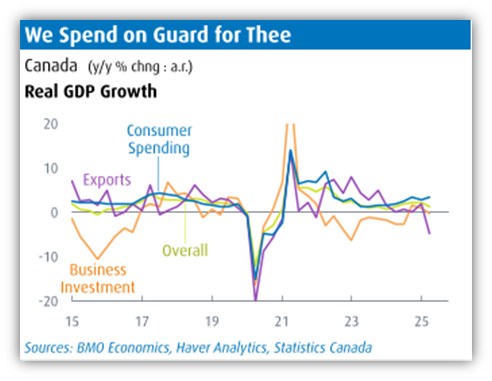
The K-shaped economy is much less apparent in Canada, and the main factor is simply that the income distribution is much flatter. The spending tally among the top 10 per cent of incomes is not in the same league as the U.S. economy.
According to StatCan, the top 20 per cent of income earners account for ‘just’ 31 per cent of total household spending so far in 2025 and about 42 per cent of total disposable income. The share of income among the top quintile has risen from pre-pandemic levels, but the share of spending has seen a much smaller gain.
Consumer spending in Canada has remained resilient, thanks in part to lower interest rates and a strong “Buy Canadian” sentiment that took over the country earlier this year. (3)
Whatever the shape of the economy: V, K, or LMNOP, the only true friend investors have is diversification. That’s because individual sectors of the economy perform differently at different times of the economic cycle. We recently trimmed exposure to real estate in favour of global consumer discretionary investments. We’re leaning into the K-shape in the U.S. but buffering it slightly by increasing exposure to global assets at the same time, thereby enhancing diversification in portfolios.
Read and Watch
Want deeper insight into topics in your Weekly Update? Then, read and/or right click:
Canada's economy grows 2.6%, beating expectations and avoiding recession
Rich people are spending. Everyone else is cutting corners.
How Europe can harness its economic power
Japan Q3 capex growth slows to 2.9%, but points to resilient demand
Looking Back
At the end of last week, the S&P/TSX composite index (TSX) edged higher as investors assessed better-than-expected GDP figures, which put the benchmark on track for its seventh consecutive month of gains. In fact, the TSX is set for its longest monthly winning streak in four years, buoyed by strength in commodity prices. The Canadian markets have long been dominated by our exposure to commodities and natural resources.
Another positive is that data released on Friday showed the Canadian economy grew at a faster pace than expected in the third quarter. (4)
U.S. stock indexes finished the holiday-shortened week higher, boosted by dovish comments from some Fed officials and several weaker-than-expected economic reports that seemed to reinforce the idea that a December rate cut will happen. Small-cap stocks outperformed their large-cap peers, as the Russell 2000 Index advanced 5.52 per cent. The Nasdaq Composite also posted strong returns, rebounding from the prior week’s sell-off as concerns regarding elevated valuations and spending on artificial intelligence (AI) appeared to take a back seat to optimism around the growth potential from the technology.
The U.S. Labor Department reported last week that initial claims for U.S. unemployment benefits came in at 216,000 for the week ended November 22, down from the prior week’s upwardly revised figure of 222,000 and marking the lowest reading since April. However, continuing claims increased by 7,000 to 1.960 million, just shy of the year-to-date high of 1.968 million reached in late July. Meanwhile, the Conference Board reported that consumer confidence fell sharply in November - its Consumer Confidence Index dropped 6.8 points to 88.7, the lowest level since April. All five components of the overall index flagged or remained weak with consumers’ write-in responses citing “prices and inflation, tariffs and trade, and politics” as the leading causes of the more negative outlook.
The pan-European STOXX Europe 600 Index closed 2.35 per cent higher. Major single-country stock indexes rose as well. Data from several regions indicated that inflation was relatively subdued in November, suggesting that broader eurozone inflation could remain around the European Central Bank’s (ECB’s) two per cent target.
Stock markets in China advanced as investor enthusiasm for domestic technology and artificial intelligence trades outweighed growth slowdown concerns. However, profits in China’s industrial sector unexpectedly fell 5.5 per cent in October year on year. This drop in industrial profits, which came after increases of more than 20 per cent in each of the prior two months, adds to evidence that China’s economy lost momentum in the fourth quarter. That said, most analysts believe that China will meet its official growth goal of about five per cent this year. (5)
The opinions expressed are those of Craig Swistun and not necessarily those of Raymond James Investment Counsel which is a subsidiary of Raymond James Ltd. Statistics and factual data and other information presented are from sources believed to be reliable, but their accuracy cannot be guaranteed. It is furnished on the basis and understanding that Raymond James is to be under no liability whatsoever in respect thereof. It is for information purposes only and is not to be construed as an offer or solicitation for the sale or purchase of securities. Raymond James advisors are not tax advisors, and we recommend that clients seek independent advice from a professional advisor on tax-related matters.
Here's why everyone's talking about a 'K-shaped' economy, Christopher Rugaber, The Canadian Press via Yahoo Finance, December 1, 2025
Does the U.S. have a 'K-shaped economy'? What it means for you., Andrea Riquier, USA Today, November 15, 2025
K-eh Shaped Economy?, Douglas Porter and Shelly Kaushik, BMO Economics, November 21, 2025
TSX poised for seven-month winning streak, Avinash P, Reuters, November 28, 2025
Global markets weekly update - U.S. jobless claims hit lowest since April, T. Rowe Price, November 28, 2025
SUBSCRIBE
If you’d like to automatically receive the Weekly Market Update by email, enter your email address in the box below.
We respect your privacy, and you can always remove yourself from the mailing at any time.
Looking to Learn?
If you want to know more about some of the topics we wrote about this week, just click on the links below:
Associated Press explains why people are talking about a ‘K-shaped’ economy
The K-Shaped Economy: Rich Keep Spending, Everyone Else Hurts
How Many Americans Own Stock? About 162 Million -- but the Wealthiest 1% Own More Than Half
