
Lexicon Financial Group Weekly Update — September 23, 2026
“Most people are really stunned to find out that the technology has been around for more than 100 years, and that the diesel engine was in fact invented to run on vegetable oil.”
ISSUE 246
Looking Around
Have you ever wondered why the price of diesel is higher than gasoline?
The war between the United States and Iran has driven energy prices higher. We’re used to hearing about the price of oil, but more and more, we’re hearing specifically about the price of diesel. And, for good reason.
Net exports of diesel and gasoil from Gulf countries averaged 390,000 barrels a day in August, a quarter of pre-war levels. Lower supply and consistent demand? Prices rise.
To deal with the higher diesel prices, President Donald Trump announced this week that he backed a ban on diesel exports from U.S. refiners to help ease prices of the fuel. This will most likely be a temporary solution as in 2025, diesel accounted for almost 30 per cent of the world’s total oil consumption. Higher diesel prices have and will continue to have major ramifications for diesel consumers and the global economy. (2)
However, there are other reasons for higher diesel prices, including:
· Higher refining costs, thanks to the introduction of Ultra-Low Sulfur Diesel (ULSD) between 2005 and 2010 for all on-road diesel requirements to reduce harmful emissions. ULSD requires more refining and this has made producing diesel more expensive.
· Governments applying higher excise taxes and carbon pricing on diesel, which pushes its price up even more.
· Seasonality which is a major factor in demand for diesel. In the cold winter months, many areas of the world use fuel made from the same essential components of diesel fuel to heat their homes. So, the colder the winter, the higher the demand and thus, the higher diesel price.
· Distribution and marketing cost that make up more than 10 per cent of fuel costs. (2)
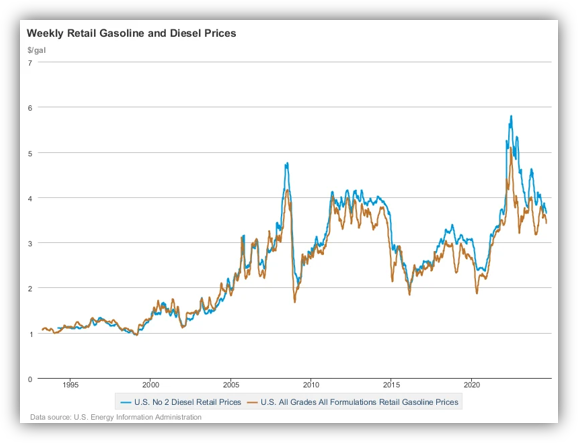
What many forget is that diesel has not always been more expensive than gasoline (see the chart below).
Diesel fuel powers the industries and infrastructure that make our modern life possible. Thanks to its unmatched energy density, fuel efficiency, durability, and performance, diesel technology powers 15 major economic sectors ranging from agriculture and freight movement to construction, mining, manufacturing, and emergency services.
No other energy source matches diesel’s ability to move heavy loads over long distances efficiently and cost‑effectively. Freight fuel use closely tracks national prosperity, moving in near-perfect alignment with GDP – an astounding 98.5 per cent correlation which underscores diesel’s role as a real-time indicator of economic health. (3)
And we can expect central banks to do what they always do when inflation rises, namely, increase interest rates. This may mean a period of increasing interest rates, which is usually a negative for stock markets and economic growth. And we are preparing for that scenario.
Read and Watch
Want deeper insight into topics in your Weekly Update? Then, read and/or right click:
Bank of Canada likely to hike rates next month as inflation pressures build, says Manulife
The U.S. economy before and after the Iran war, in five charts
Soaring Oil and Gas Prices Push Europe's Inflation Fight Into 2027
Looking Back
Although the S&P/TSX Composite Index (TSX) edged lower last Friday due to declines in energy and industrial shares, as long-term borrowing costs increased, it still posted a weekly gain of 0.3 per cent. This is its first gain after four straight weeks of decline. The TSX remains grounded by the real possibility of the Bank of Canada (BoC) having its tightening hand forced by persistently strong energy prices. Investors see a 65 per cent chance of the BoC raising its interest rates next month. (4)
Major U.S. stock indexes finished mixed last week, which featured the Fed’s first rate increase since 2023 and volatile oil prices resulting from escalation in the Middle East conflict. Artificial intelligence (AI)-related stocks once again largely shrugged off the warnings about safety risks from high-profile AI leaders over the previous weekend, which helped the technology-heavy Nasdaq Composite Index outperform. Growth stocks also outpaced value in the large-cap Russell 1000 Index universe, while the small-cap Russell 2000 Index lagged.
Earlier last week, the 10-year Treasury yield had reached 5.04 per cent – the highest level since 2007. Investors, however, seemed to gain confidence in the central bank’s inflation-fighting credibility, as the yield on the 10-year note decreased to 4.94 per cent on Thursday before rising again on Friday. The rapidly evolving conflict in the Middle East drove crude oil prices significantly higher at the beginning of last week, following attacks on pipeline infrastructure in Saudi Arabia. Diesel fuel prices in the U.S. surged to record highs, raising investor fears about inflation that the Fed’s rate hike only partially eased.
The pan-European STOXX Europe 600 Index dropped 0.57 per cent in local currency terms last week. European equities were volatile as escalating Middle East tensions drove oil and natural gas prices higher early in the week, which reinforced inflation concerns and put upward pressure on bond yields. A sharp rotation out of AI-related stocks also weighed on sentiment before tech stocks rebounded as concerns about infrastructure spending moderated. Other major European stock markets also ended last week lower.
Japan’s stock markets rose last week as AI-related shares recovered from a sharp early-week sell-off and improved sentiment. Oil prices retreated from earlier highs on easing concerns about immediate Middle East supply disruptions. The Bank of Japan’s (BoJ) widely expected rate hike was accompanied by a split vote and an absence of explicit guidance on the pace of further tightening.
The performance of mainland China stock markets was mixed last week. Early weakness was concentrated in AI-related shares and other growth stocks amid a regional technology sell-off, higher oil prices, and softer domestic demand and credit data. Losses narrowed later in the week as semiconductors and other technology shares rebounded sharply. Friday’s recovery broadened across mainland and Hong Kong technology shares, with semiconductors and other AI-related names leading, while the renminbi strengthened to its highest level in more than four years. China’s August activity data highlighted a further widening divide between relatively resilient industrial production and subdued domestic demand. Industrial production rose 5.2 per cent year over year, ahead of expectations, and went up from 4.5 per cent in July, supported by higher-value-added manufacturing, while retail sales increased just 0.4 per cent, slowing from a 0.6 per cent gain in July. Fixed asset investment declined 7.2 per cent in the first eight months from the same period last year, while real estate investment fell 19.9 per cent. These weaker consumption, property, and credit readings contrasted with continued strength in technology-related manufacturing and reinforced the highly differentiated backdrop across the stock markets. (5)
Diesel prices hit record highs as wars squeeze global supplies, Emma Graney, The Globe and Mail, September 22, 2026
Why Does Diesel Fuel Cost More Than Gasoline? DTN Team, DTN
Of Davos and Diesel: The Critical Importance of Diesel to the Global Economy, Allen Schaeffer, Engine Technology Forum, January 19, 2026
TSX ends lower as bond yields rise, index snaps weekly losing streak, Utkarsh Hathi and Fergal Smith, Reuters, September 18, 2026
Inflation worries send bond markets tumbling, T. Rowe Price, September 2026
The opinions expressed are those of Craig Swistun and not necessarily those of Raymond James Investment Counsel which is a subsidiary of Raymond James Ltd. Statistics and factual data and other information presented are from sources believed to be reliable, but their accuracy cannot be guaranteed. It is furnished on the basis and understanding that Raymond James is to be under no liability whatsoever in respect thereof. It is for information purposes only and is not to be construed as an offer or solicitation for the sale or purchase of securities. Raymond James advisors are not tax advisors, and we recommend that clients seek independent advice from a professional advisor on tax-related matters.
SUBSCRIBE
If you’d like to automatically receive the Weekly Market Update by email, enter your email address in the box below.
We respect your privacy, and you can always remove yourself from the mailing at any time.
Looking to Learn?
If you want to know more about some of the topics we wrote about this week, just click on the links below:
Understanding How Diesel Fuel is Priced in Canada, the USA, and the World
Audio: Why is diesel so much more expensive than gasoline?
3 things to know about rising diesel prices and how they affect you
