
Lexicon Financial Group Weekly Update — September 9, 2026
“Never try to time the bond market. Anyone who claims to know the future of interest rates is certifiable.”
ISSUE 244
Looking Around
Bonds are often seen as being boring. Maybe that’s because, for decades, they’ve been looked at as the “safer” part of an investment portfolio. By default, that would make a riskier investment such as a stock seem more exciting. Until it isn’t. Because both are equally important when constructing investment portfolios.
Bonds are also known as “fixed income” investment products. Generally, individuals lend money to a government or company at a specified interest rate for a predetermined period. The government or company pays a regular amount of interest, and at the end of the period, returns the full amount of the initial loan.
The initial price is known as the “face value” and the interest rate is known as the “coupon.” So, if you were to invest $10,000 in a government bond paying two per cent, with a maturity date three years from now, you would receive your $10,000 back at maturity while earning two per cent interest each year along the way.
And that’s where it can get confusing. If you hold the bond until it matures, we know exactly what to expect. Assuming the issuer remains financially sound and meets its obligations, there is a high degree of certainty about what the bond will pay at maturity. (This opens up a conversation about credit ratings, which is beyond the scope of this week’s update but let us know if you want to learn more about them.)
Markets allow lenders to buy or sell their bonds to other investors long after the original issuing organization has raised capital. You do not have to hold a bond through to its maturity date. Bonds can be sold on the open market. In fact, the global bond market is larger than the global stock market.
But what isn’t boring about bonds is their daily prices (which change based on supply and demand), the issuer's perceived ability to meet its repayment obligations, and the current interest rates. Bond prices vary inversely with interest rates. When interest rates go up, bond prices fall to equalize the interest rate on the bond with prevailing rates, and vice versa. (1)
Yet, the popular press often talks about bonds in terms of a “yield.”
When you hear that "U.S. bond yields have risen," it does not mean bondholders are suddenly receiving larger coupon payments. Existing bonds continue to pay the same interest they always have. What has changed is the market price of those bonds. As prices fall, the fixed income stream represents a higher return for new buyers, which causes yields to rise. Conversely, when bond prices rise, yields fall.
And you thought bonds were boring.
Look at it this way. The $10,000 bond you purchased is generating two per cent or $200 of interest income every year for three years. When rates change, let’s assume they rise. What happens? If you hold the bond to maturity… well, nothing happens. You get your $200 each year and your full $10,000 back in three years’ time. But if you try and sell it in the market, you’ll notice that the price will have changed. If newly issued three-year government bonds are now offering three per cent, investors won't pay $10,000 for your bond because it only pays $200 per year while a new $10,000 bond pays $300 per year. The price of the bond drops and as it does, the bond's yield rises.
In this example, the bond's value would fall to roughly $9,700 because investors are purchasing not only the three annual $200 interest payments, but also the $10,000 principal that will be repaid at maturity.
Inflation and interest rates are closely linked. When inflation rises, central banks often increase interest rates to slow economic activity. Higher borrowing costs can reduce spending and encourage saving, helping to bring inflation back under control. Because bond prices move inversely to interest rates, rising inflation can place downward pressure on bond prices.
Canada’s financial institutions borrow money from one another to settle payments at the end of every day, and the policy rate determines the interest charged on this lending, which then influences the rates banks charge on things like mortgages, business loans, etc. If these rates go up, spending by businesses and consumers would be expected to decline.
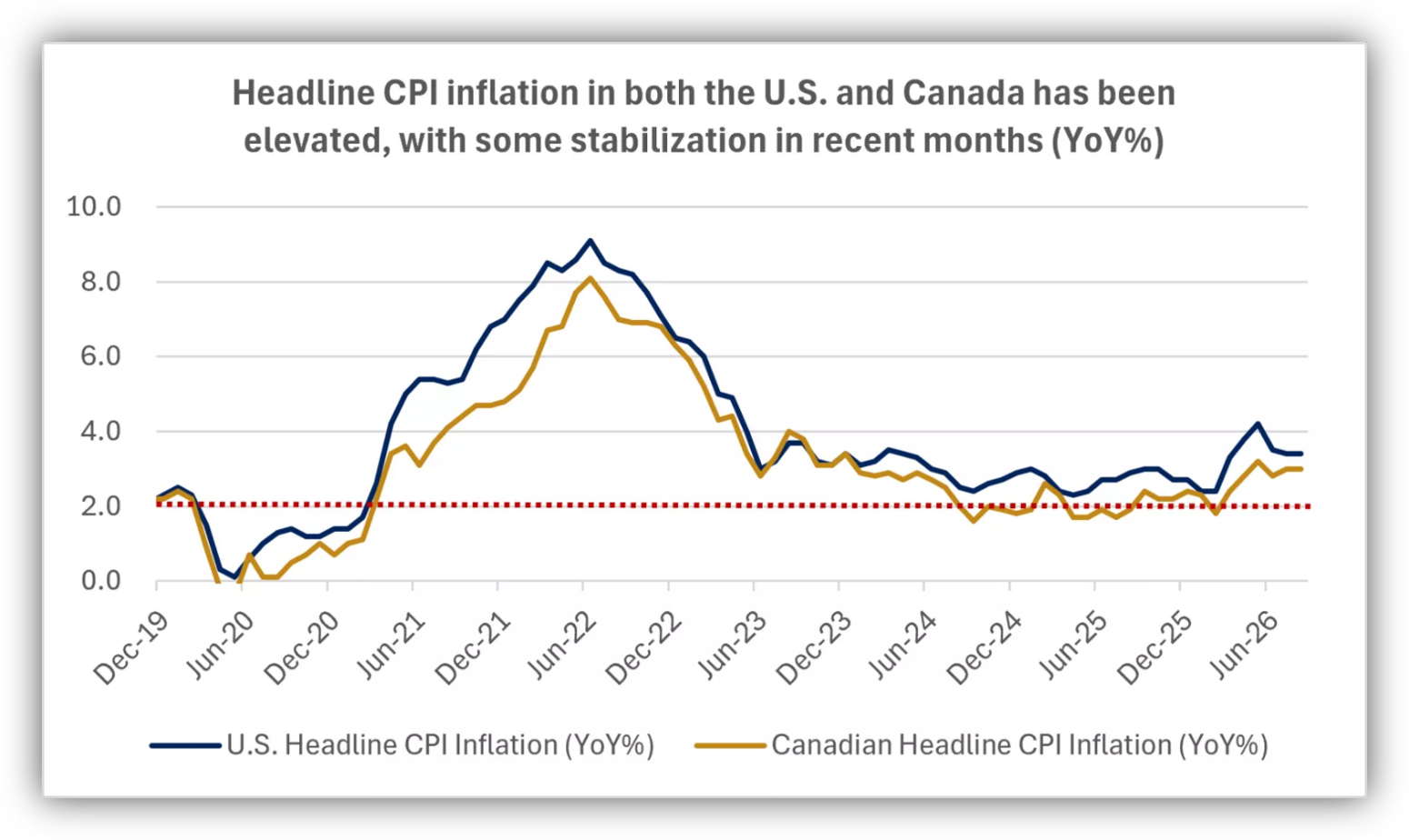
Source: Bloomberg and Edward Jones: The chart shows that headline CPI inflation in both the U.S. and Canada has been elevated, with some stabilization in recent months.
Higher interest rates may encourage people to save more money. They’ll see higher rates on savings accounts. More money being saved equals less money being spent, which reduces inflation. With less demand, retailers don’t raise their prices as quickly and inflation slows. (2)
And this is why the current discussion about interest rates and inflation in the United States is important. For a long time, U.S. Treasuries (bonds) have been seen as one of the most stable investments in the world. But investor concerns over issues including rising inflation, the continuing war with Iran, and the U.S.’s record national debt ($40 trillion and counting) have shaken the market and slowed demand for these treasurys.
Recent headlines have focused on higher long-term U.S. Treasury yields. But remember yield, interest rate and coupon are not exactly the same thing. A rise in Treasury yields does not mean existing bondholders are receiving larger interest payments. It reflects a decline in the market price of existing bonds, which increases the return available to new buyers. While higher yields can create short-term volatility in bond prices, they also improve the income and return potential available to new investors going forward.
Higher yields in the bond market suggest that investors are demanding greater compensation for risks that include inflation, government borrowing levels and geopolitical uncertainty.
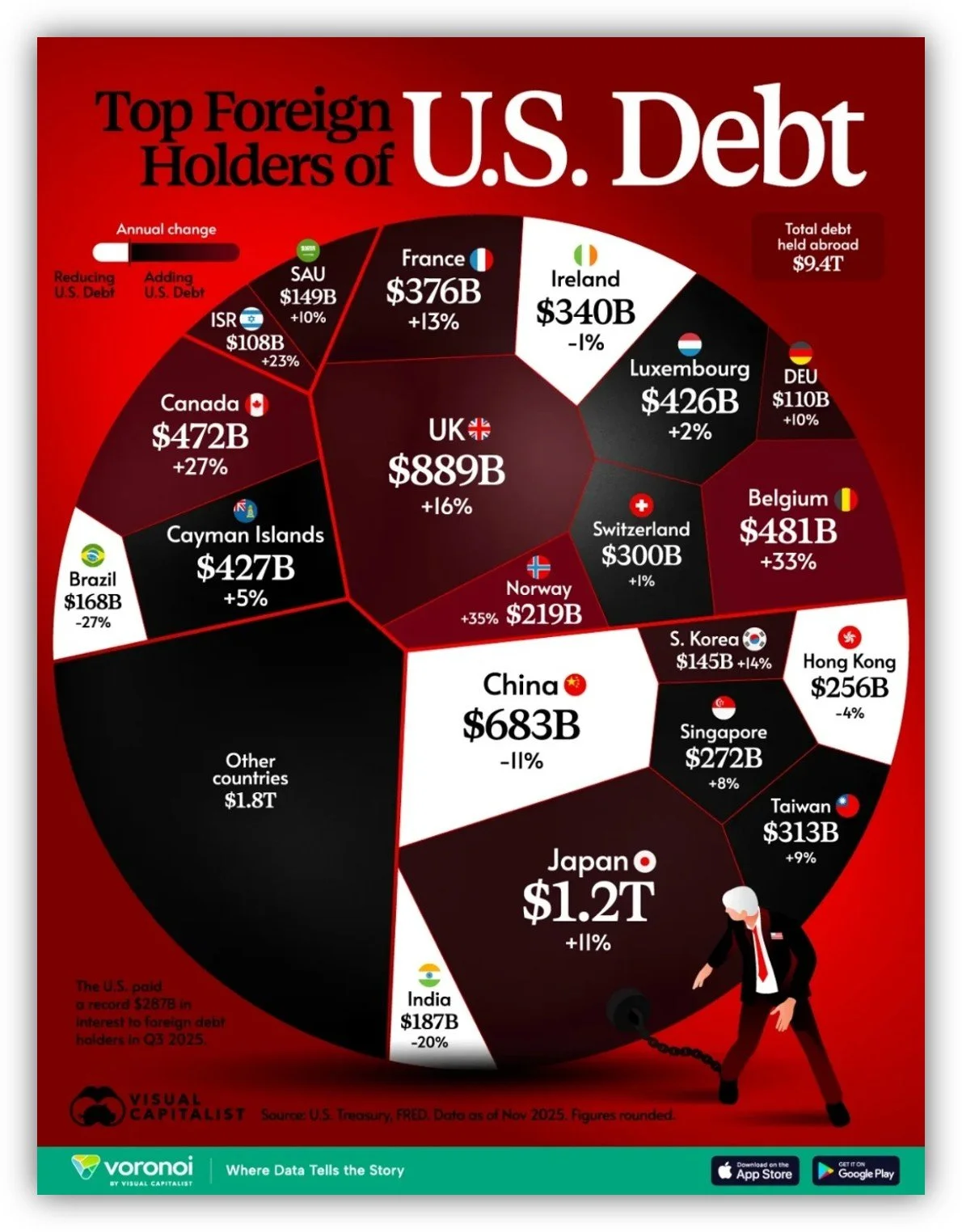
As inflation expectations have risen, investors have demanded higher yields to compensate for the risk that future interest rates could remain elevated. Higher interest rates also increase the cost of servicing debt. And, with the U.S. debt currently sitting at about $40 trillion, well… that’s a lot of interest.
At the end of February this year, the yield rate for the 10-year treasury was 3.95 per cent. On Wednesday this week, it hit 4.8 per cent. According to Alex Jacquez, senior vice-president of policy, advocacy and research at the progressive thinktank Groundwork Collaborative and a former economic advisor to the Biden administration, there is little the Trump administration can do in terms of the U.S. bond market, if it continues to pursue inflationary policies such as continuing the conflict in the Middle East and applying new tariffs on close trading allies. (3)
So perhaps, bonds are not as boring as their reputation suggests. While their income payments may be predictable, their market prices respond daily to changes in interest rates, inflation expectations and investor sentiment. We have to take all this into account when constructing a well-diversified portfolio. Hopefully, this brings the headlines into context and shows how important fixed income continues to be in the global economy.
Read and Watch
Want deeper insight into topics in your Weekly Update? Then, read and/or right click:
Canada’s economic growth expected to rebound, but risks remain on the horizon: report
What a Fed Rate Hike Actually Means for the U.S. Economy and Inflation
EU's summer of "hellish heat" adding to inflation pressures, says UN climate chief
Why Japan matters for U.S. bond investors
Chinese stock recovery faces US Fed and oil pressures in September, says top fund manager
Looking Back
Canada’s main stock index, the S&P/TSX Composite Index (TSX), closed lower last Friday, as material and oil stocks declined and stronger-than-expected U.S. jobs data prompted investors to increase bets on an interest-rate hike by the Fed this month. Canada's economy lost 41,700 jobs in August, which is a sharp slowdown from unusually strong summer hiring. The Bank of Canada held interest rates steady, but Governor Tiff Macklem said policymakers were prepared to hike multiple times if inflation remained too high. Renewed strikes in the Middle East pushed up oil prices and bond yields earlier last week, creating an uncertain backdrop for risk assets. For the week, TSX fell 0.1 per cent. (4)
Again, major stock indexes in the U.S. finished last week mixed albeit narrowly, as investors weighed renewed U.S.-Iran hostilities, rising oil prices, a better-than-expected jobs report, and shifting Fed monetary policy expectations. The Dow Jones Industrial Average lost 0.27 per cent while the Nasdaq Composite added 0.40 per cent. The S&P 500, Russell 2000, and S&P MidCap 400 Indexes were little changed. Growth stocks outperformed their value counterparts by the widest margin in a month. Within the S&P 500, the energy sector posted the strongest gains as oil prices rose amid renewed Middle East tensions.
Treasury yields moved higher alongside oil prices; with the benchmark 10-year U.S. Treasury note yield reaching roughly 4.82 per cent on Wednesday before retracing somewhat on Thursday. However, yields across most maturities resumed their upward climb after Friday’s better-than-expected jobs report appeared to increase expectations for a near-term Fed rate hike.
The Labor Department reported last Friday that U.S. employers added 162,000 jobs in August. This was well above estimates for around 55,000 and up sharply from July’s upwardly revised gain of 21,000. June's figure was also revised higher, leaving employment gains for June and July a combined 55,000 above previous estimates. The unemployment rate held steady at 4.1 per cent.
The pan-European STOXX Europe 600 Index ended last week almost one per cent down in local currency terms. European equities came under pressure early in last week, as renewed U.S.-Iran hostilities pushed oil and natural gas prices higher, which fueled concerns about inflation and drove up government bond yields. Technology stocks, however, benefited from renewed enthusiasm around artificial intelligence (AI). The energy shock reinforced concerns that inflation could remain elevated for longer, contributing to a sharp increase in sovereign bond yields.
Japan’s stock markets fell last week. Rising Japanese government bond (JGB) yields and mounting expectations for near-term Bank of Japan (BoJ) monetary policy tightening weighed on highly valued growth stocks, while a sharp strengthening of the yen later in the week added pressure on exporters. Sentiment weakened further as renewed U.S.-Iran tensions drove oil prices higher. However, a rebound in technology shares and easing bond yields helped Japanese stock markets recover some ground by the end of the week.
China stocks diverged last week, as fading momentum in AI-related shares weighed on mainland China stock markets, while Hong Kong recovered sharply last Friday. On the mainland, a midweek rise in oil prices and global bond yields amplified selling in semiconductors and other AI-related growth shares, while more traditional areas of the market, including consumer staples, agriculture, and media, held up relatively better. (5)
Bonds: How They Work and How to Invest, Jason Fernando, Investopedia, April 28, 2026
How higher interest rates affect inflation, Bank of Canada, December 21, 2023
Trouble in US bond market could mean higher prices are here to stay, Lauren Aratani, The Guardian, September 10, 2026
TSX declines after US jobs data fuels rate-hike bets, Purvi Agarwal, Reuters, September 4, 2026
U.S. job gains surge in August, T. Rowe Price, September 2026
The opinions expressed are those of Craig Swistun and not necessarily those of Raymond James Investment Counsel which is a subsidiary of Raymond James Ltd. Statistics and factual data and other information presented are from sources believed to be reliable, but their accuracy cannot be guaranteed. It is furnished on the basis and understanding that Raymond James is to be under no liability whatsoever in respect thereof. It is for information purposes only and is not to be construed as an offer or solicitation for the sale or purchase of securities. Raymond James advisors are not tax advisors, and we recommend that clients seek independent advice from a professional advisor on tax-related matters.
SUBSCRIBE
If you’d like to automatically receive the Weekly Market Update by email, enter your email address in the box below.
We respect your privacy, and you can always remove yourself from the mailing at any time.
Looking to Learn?
If you want to know more about some of the topics we wrote about this week, just click on the links below:
Fixed-Income Security Definition, Types, and Examples
U.S. gross national debt tops $40tn for first time
How The 10 Year US Treasury Note Impacts Mortgage Rates
Bond market rebuffs U.S. treasury’s plan to buy back $6bn in government debt
