
Lexicon Financial Group Weekly Update — August 19, 2026
“What you do makes a difference, and you have to decide what kind of difference you want to make.”
ISSUE 241
Looking Around
This is a somewhat sombre and reflective weekly update. Many readers may recognize the name Irina Dorogan. We recently learned that she passed away unexpectedly in July. Of course, the news came as a complete shock to those who knew her.
Irina joined Cougar Global Investments (CGI) in 2010 as an analyst, supporting the investment strategies developed by Dr James Breech. By the time I joined Cougar as Head of Wealth Management in 2019, the scope of her work and her responsibilities had expanded tremendously.
Irina made significant contributions to the investment strategies. She provided deep and meaningful research on the evolving global exchange-traded fund industry. Importantly, she brought a broader worldview to the investment discussions. Originally from Moldova, Irina once worked with the Turkish embassy. She spoke multiple languages (you could often here her speaking Romanian with Wayne in the office hallway or French with our Chief Compliance Officer).
I worked extremely closely with Irina.
During the fall of 2019, we tasked ourselves to build a new line of portfolio strategies for the global institutional marketplace. These portfolios would be thematically aligned with the United Nations Sustainable Development Goals.
The United Nations (U.N.) Sustainable Development Goals (SDGs) are 17 global goals adopted by all UN member states in 2015. Designed as a shared blueprint for peace and prosperity, they set a target to end poverty, protect the planet, and improve lives worldwide by the year 2030. Nations were deploying capital in support of these objectives, which we believed would be a catalyst for economic investment for decades to come.
Irina and I worked daily to adapt our internal macro-economic scenario analysis, ultimately creating an investment hypothesis around three of the U.N.’s SDG goals: Global Health, Clean Water and Sanitation, and Gender Equality and Women’s Empowerment. We built and back-tested portfolios, ensuring that they met the needs of institutional investors that were looking to make meaningful changes to the way they deployed investment capital.
Just as we were preparing to launch these new structures in early 2020, COVID emerged and changed everything overnight. Institutional investors were grappling with rapid changes in current capital markets; investment teams were struggling to adapt to new “work from home” restrictions. It was unfortunately not the right time to launch new ideas and initiatives into the marketplace.
However, I do recall the passion and energy that Irina poured into that project. The debates, discussions, and analysis that we had formed the foundation of something that we were both extremely proud of. In fact, we still apply some of those ideas to portfolio construction today, especially for nonprofit or charity clients or those looking to align their investment with their social or organisational mission. Irina’s passing will have no direct impact on current client portfolios. Our investment team (myself, Antoine Natale, Louis Gervais) continue to meet weekly and make adjustments as required.
For Wayne and I, it really was an honour and privilege to have known and worked with Irina. We are grateful to have had the opportunity to know her and will always value our collaboration.
Read and Watch
Want deeper insight into topics in your Weekly Update? Then, read and/or right click:
S&P/TSX Composite Index Ends the Week 0.96% Higher at 36730.27 — Data Talk
U.S. economy is losing momentum: Rosenberg
What Europe’s Extreme Summer Means for Stocks and the Economy
Japan's economy manages 1.1% growth rate despite headwinds
Commentary: This bad movie is a good guide to China’s stock market
Looking Back
Canada's commodity-linked main stock index, the S&P/TSX Composite Index (TSX), returned a small part of its weekly gain on Friday as losses for the technology sector offset gains for energy and metal mining sectors.
The TSX posted a record closing high last Thursday and ended last week with a gain of nearly 1 per cent. (1)
Major U.S. stock indexes finished last week mixed as investors weighed easing concerns about inflation and Federal Reserve policy and some favourable artificial intelligence (AI)-related earnings news against news of rising oil prices, ongoing uncertainty surrounding the Strait of Hormuz, and weaker-than-expected consumer data. The Russell 2000 and S&P MidCap 400 Indexes performed best, adding over per cent each, while the S&P 500 Index posted more modest gains. The Dow Jones Industrial Average finished the week lower, and the Nasdaq Composite was little changed.
Last week, the Bureau of Labor Statistics (BLS) reported that its consumer price index (CPI) rose 0.1 per cent in July and 3.4 per cent over the prior 12 months. This was in line with consensus estimates as was core CPI—which excludes food and energy costs—that increased 0.2 per cent month over month and 2.5 per cent year over year. July marked the second consecutive month in which both headline and core CPI inflation eased on a year-over-year basis, with both measures declining 0.1 percentage point from June.Canada's commodity-linked main stock index, the S&P/TSX Composite Index (TSX), returned a small part of its weekly gain on Friday as losses for the technology sector offset gains for energy and metal mining sectors.
The TSX posted a record closing high last Thursday and ended last week with a gain of nearly one per cent. (1)
Major U.S. stock indexes finished last week mixed as investors weighed easing concerns about inflation and Federal Reserve policy and some favourable artificial intelligence (AI)-related earnings news against news of rising oil prices, ongoing uncertainty surrounding the Strait of Hormuz, and weaker-than-expected consumer data. The Russell 2000 and S&P MidCap 400 Indexes performed best, adding over one per cent each, while the S&P 500 Index posted more modest gains. The Dow Jones Industrial Average finished the week lower, and the Nasdaq Composite was little changed.
Last week the Bureau of Labor Statistics (BLS) reported that its consumer price index (CPI) rose 0.1 per cent in July and 3.4 per cent over the prior 12 months. This was in line with consensus estimates as was core CPI—which excludes food and energy costs—that increased 0.2 per cent month over month and 2.5 per cent year over year. July marked the second consecutive month in which both headline and core CPI inflation eased on a year-over-year basis, with both measures declining 0.1 percentage point from June.
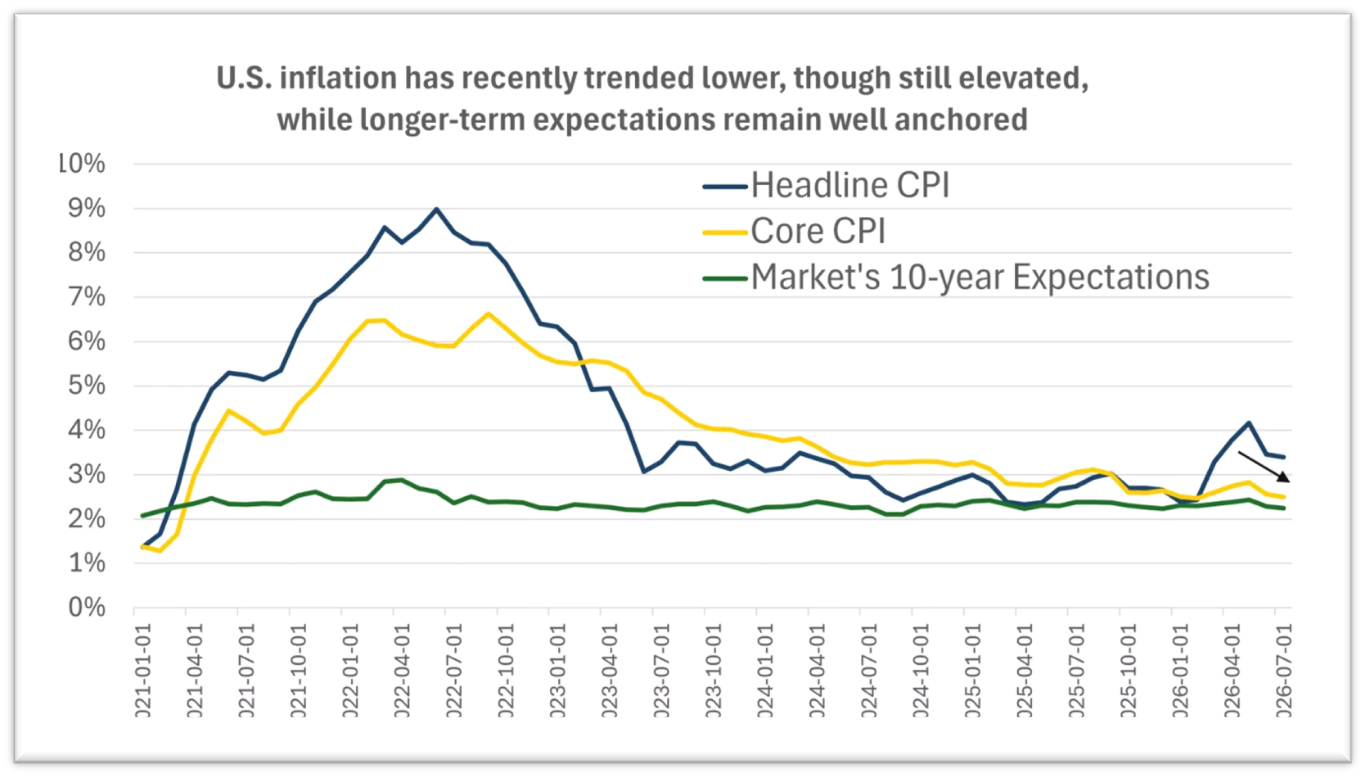
Source: FRED and Edward Jones. The market's 10-year expectations represented by 10-year inflation breakeven.
The softer inflation reports helped reduce expectations for near-term monetary policy tightening in the form of higher interest rates. Futures markets last Friday were pricing a roughly 32 per cent chance of a rate hike at the Fed’s September meeting, down from around 52 per cent earlier in the week, according to the CME FedWatch Tool.
On the economic front, retail sales in the United States (U.S.) fell 0.6 per cent month over month in July. This overshot estimates for a 0.1 per cent increase and down from June’s 0.2 per cent rise—this was the largest monthly drop since May 2025. Also, the University of Michigan reported that a preliminary reading of its August Index of Consumer Sentiment came in at 51, dropping 4.2 points from July and snapping a two-month streak of increases. This decline was driven by a sharp drop in short- and long-run expectations for business conditions.
The pan-European STOXX Europe 600 Index ended last week down 0.36 per cent in local currency terms. Investors weighed resilient regional economic data and generally solid corporate earnings against persistent geopolitical uncertainty due to the U.S.-Iran conflict and the Strait of Hormuz. Other major European stock indexes ended mixed last week.
Japan’s stock markets registered substantial gains last week, thanks largely to strong technology earnings, led by memory companies. Japan’s export-oriented industries were also boosted by the yen’s retreat, which weakened to around JPY 159 against the U.S. dollar from about JPY 157.9 at the end of the previous week, despite recent Japanese authorities and the U.S. recent currency interventions. Bank shares benefited from reports signaling that an interest rate hike by the Bank of Japan (BoJ) could be imminent. The Bloomberg news agency, citing unnamed sources, suggested that the Japanese government is supportive of a near-term BoJ rate hike because the weakness of the yen is feeding into inflationary pressure that is leaving Japanese households grappling with increasing living costs. Japan’s government also stated that it believes specific monetary policy measures, including interest rate hikes, should be left to the BoJ, but the central bank should work closely with the government to achieve its two per cent inflation target in a stable manner.
China equities ended the week lower after markets started the week well, led by strength from the consumer and property segments. But the momentum faded amid losses for precious metals stocks. Optical component companies, however, fared well on the back of strong forecasts from U.S. AI firms. (2)
TSX trims weekly advance as tech shares decline, Fergal Smith, Reuters, August 14, 2026
Global markets weekly update - U.S. inflation eases in July, T. Rowe Price, August 2026
The opinions expressed are those of Craig Swistun and not necessarily those of Raymond James Investment Counsel which is a subsidiary of Raymond James Ltd. Statistics and factual data and other information presented are from sources believed to be reliable, but their accuracy cannot be guaranteed. It is furnished on the basis and understanding that Raymond James is to be under no liability whatsoever in respect thereof. It is for information purposes only and is not to be construed as an offer or solicitation for the sale or purchase of securities. Raymond James advisors are not tax advisors, and we recommend that clients seek independent advice from a professional advisor on tax-related matters.
SUBSCRIBE
If you’d like to automatically receive the Weekly Market Update by email, enter your email address in the box below.
We respect your privacy, and you can always remove yourself from the mailing at any time.
Looking to Learn?
If you want to know more about some of the topics we wrote about this week, just click on the links below:
THE 17 GOALS - Sustainable Development Goals
What is Environmental Sustainability and Why is It Important?
