
Artificial Intelligence and Cybersecurity
Wayne Hendry
Client Experience Manager
Lexicon Financial Group of Raymond James Investment Counsel
Right now, there is a high-speed race taking place. It’s a battle between technology companies, national governments, and academics to build the world’s most advanced artificial intelligence (AI) system. Having the most advanced technology certainly may have benefits for businesses and economies. Unfortunately, this technology also makes it easier for criminals, too, who leverage the technology to take advantage of unsuspecting consumers.
Cyberattacks are more sophisticated than ever before. From AI-generated phishing emails and fake websites to deepfake videos and injecting malicious prompts or code, AI is making it faster and easier for cyber criminals to gain access to sensitive data undetected. In a way, AI has democratized cybercrime by making the barrier to entry lower than ever. For example, would-be phishers don’t need to learn English or develop a polished, believable message to gain access into a data system. AI can write, spellcheck, and even adjust language for regional dialects in seconds.
According to Naveen Balakrishnan, managing director at TD Securities, hackers have access to incredible AI tools that allow them to search public data, personal information of their victim and then implement very personalized deep phishing tactics. AI has also enabled hackers to scale their attempts at an unprecedented pace and generate malware code en masse to automate attacks.
“1200% surge in phishing since the rise of gen AI in late 2022”
Thankfully, AI isn’t only a powerful tool for hackers. Cybersecurity professionals are also using it, building robust defenses to protect data and privacy. AI systems are always on, always analyzing systems and platforms. This enables them to significantly reduce the time it takes to identify threatened systems and take the steps necessary to prevent an attack.
Growing threats to cybersecurity have led to a surge in spending by individuals, corporations, and government determined to protect their data and confidential information. It is estimated that global spending is set to exceed $400 billion by 2030 – an almost 10 per cent annual growth rate.
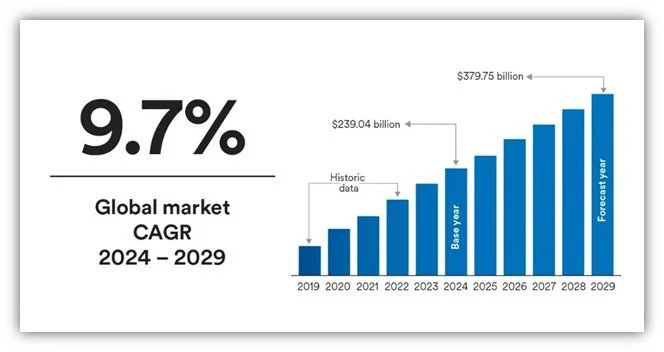
Source: Schroders Wealth Management
Larger, more established players are increasingly acquiring smaller competitors to expand their product portfolios and customer base, thereby increasing their market share and competitive positioning. This improves their ability to innovate and grow, building better tools. In turn, this may make them attractive investment prospects. (2)
Raymond James takes the cybersecurity of clients seriously. All staff are required to complete annual training, and millions have been invested in systems and technology to protect client data. For example, our systems automatically encrypt any communication sent that potentially contains personal information.
Protecting against cyberattacks is important, but there are simple steps we can adopt that will help.
Assign a “trusted contact person” to your account. This is someone who will have no access to your personal information, but we can contact if we suspect fraud, financial exploitation or notice signs of cognitive decline. A trusted contact does not make decisions or hold power but is an extra and human layer of security to protect your assets and privacy.
Always use strong, unique passwords when accessing information online and make sure that all of your devices are updated and running up-to-date systems and software.
Communicate regularly with financial professionals. For example, if we know in advance that a client is making a major purchase or withdrawal in the next three months, we are not surprised when a request for a withdrawal comes through.
Artificial intelligence isn’t going away anytime soon – it’s is here to stay. Consequently, cybersecurity is now more important than ever and is becoming a significant contributor to the global economy. More importantly, though, the growth of this industry is reassuring as it is meant to protect you and us, as well as our data.
AI and the Future of Cybersecurity, Lizzie Short, Harvard Extension School, August 1, 2025
Cybersecurity: the investment perspective, Josh Barber, Schroders Wealth Management, October 28, 2024
Craig Swistun is Portfolio Manager with Lexicon Financial Group (www.lexiconfinancialgroup.com) at Raymond James Investment Counsel.
The opinions expressed are those of Craig Swistun and Wayne Hendry and not necessarily those of Raymond James Investment Counsel which is a subsidiary of Raymond James Ltd. Statistics and factual data and other information presented are from sources believed to be reliable but their accuracy cannot be guaranteed. It is furnished on the basis and understanding that Raymond James is to be under no liability whatsoever in respect thereof. It is for information purposes only and is not to be construed as an offer or solicitation for the sale or purchase of securities. Raymond James advisors are not tax advisors and we recommend that clients seek independent advice from a professional advisor on tax-related matters.
